
Last Updated: June 19, 2026
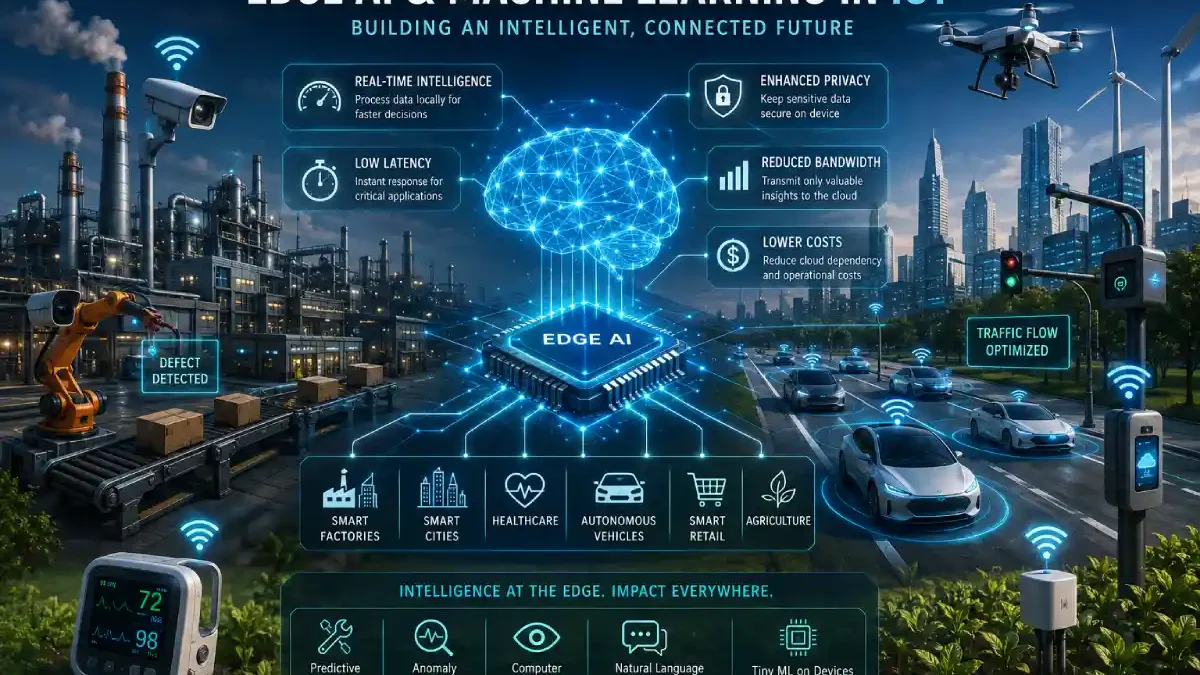
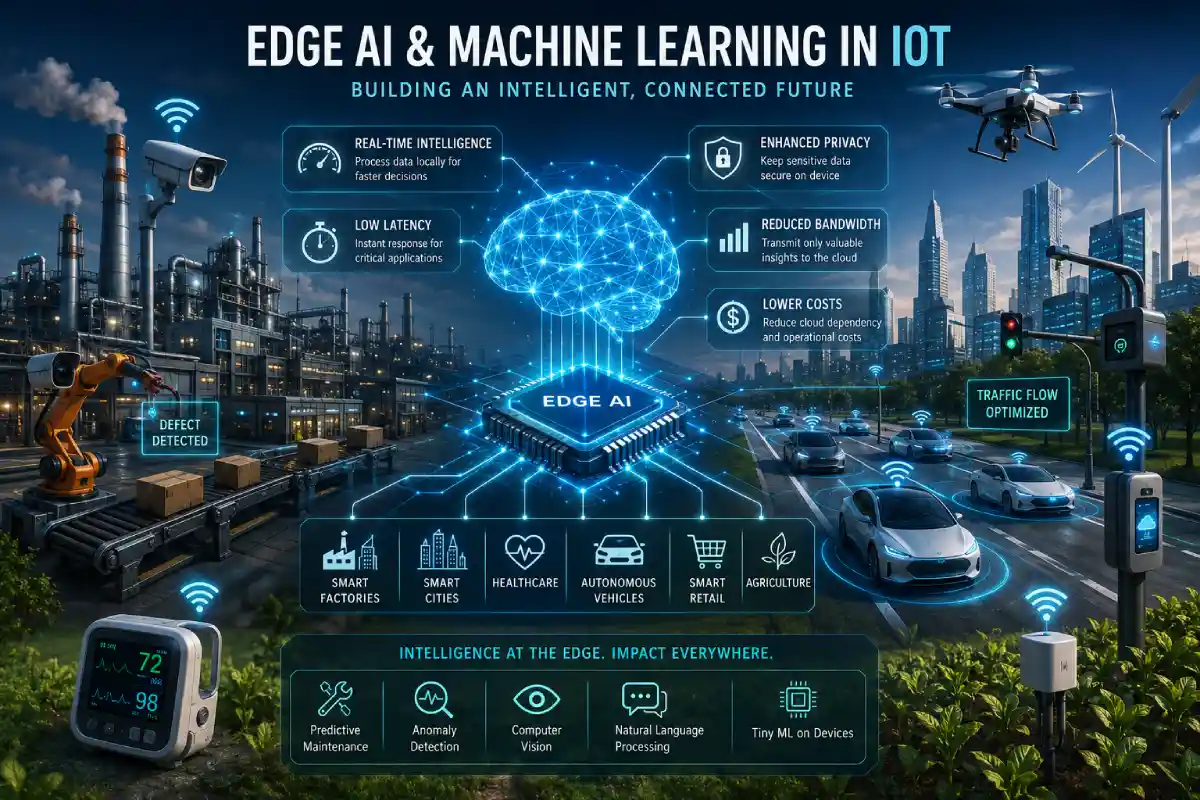
Edge AI & Machine Learning in IoT – Already connecting billions of devices ranging from smart homes, smart healthcare devices and industrial IoT sensors to autonomous devices and smart cities across the globe, the Internet of Things (IoT) networks are only growing day by day. But when it comes to smart cloud-based solutions for analyzing those streams of data, the challenges in latency, bandwidth, privacy, as well as cost of operation is proving to be an hurdle. However, with Edge AI & ML in IoT, that barrier is breaking, as they are enabling data to be analyzed on device or close to the data source rather than being transported all the way to the cloud.
IoT devices coupled with ML capabilities can respond intelligently to the dynamics in the environment, make smart decisions in real-time and run very efficiently than any previous solutions.
By 2026, industries that will be heading toward automation and a smart infrastructure will continue to make the use of Edge AI more critical and imperative.
Table of Contents
What is Edge AI in IoT?
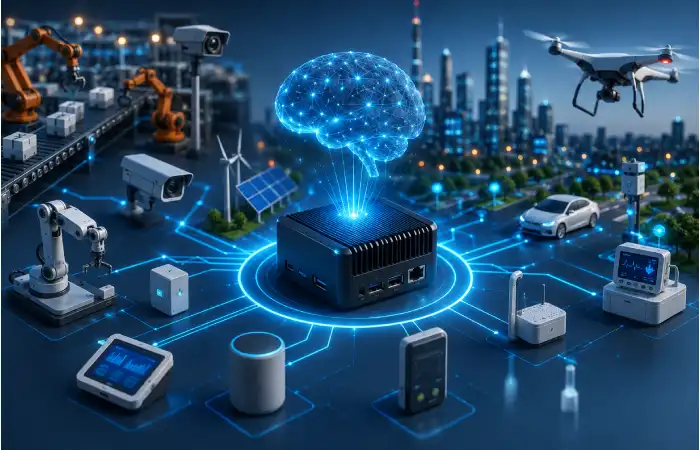
Edge AI: The Future is Already Here Edge AI is an abbreviation of Artificial Intelligence used on edge computing that utilizes devices with low computing power, such as smartphones or IoT devices instead of central server.
In a traditional IoT setup:
- Sensors collect data.
- Data is transmitted to the cloud.
- AI models process the information.
- Results are sent back to the device.
With Edge AI:
- Data is collected.
- AI processing happens locally.
- Instant decisions are made on-device.
This will achieve minimal communication delays with enhanced privacy and efficiency.
Key Components of Edge AI
| Component | Function |
| IoT Sensors | Collect environmental data |
| Edge Device | Performs local processing |
| AI Model | Analyzes patterns and predictions |
| Connectivity | Communicates with cloud if necessary |
| Cloud Platform | Long-term storage and advanced analytics |
Why Edge AI Matters for IoT
Every second generates massive amounts of data through device interconnectedness.
Consider:
| Industry | Daily Data Generated |
| Smart Factory | Several TBs |
| Autonomous Vehicle | Up to 20 TB |
| Smart City Sensors | Millions of records |
| Healthcare Monitoring | Live streaming. |
A lot of that information being dumped on cloud servers can cause them to back up a bit.
Benefits of Edge AI
- Faster response times
- Reduced bandwidth costs
- Better privacy protection
- Lower cloud dependency
- Improved reliability
- Real-time intelligence
These capabilities also make Edge AI excellent for use in mission-critical applications, where milliseconds matter.
How Edge AI Works in IoT Systems
The process of working with Edge AI is quite basic.
Step 1: Data Collection
Sensors capture information such as:
- Temperature
- Pressure
- Video footage
- Sound signals
- Motion patterns
- Energy consumption
Step 2: Local Processing
Edge devices then apply existing models to real-time data.
Step 3: Decision Making
The device detect and respond pattern on real time.
Examples:
- Smart cameras detect intruders.
- Manufacturing robots identify defects.
- Traffic systems adjust signal timing.
Step 4: Cloud Synchronization
Data only that proves to be useful sent to cloud for storing and further analysis . Hybrid architecture offers speed and scalability to both.
Best Edge AI Frameworks
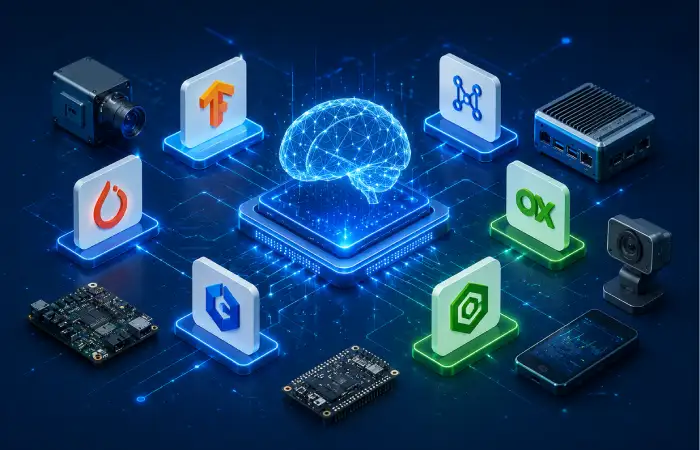
As Edge AI continues to become evermore relevant to the development of smart applications and the growing number of IoT-enabled devices, framework developers have been able to provide even more specialized solutions for deploying on the likes of cameras, sensors, gateways, and microcontroller-based hardware. Picking the right option is crucial, as a whole host of attributes including: the target device hardware, model complexity, expected performance and your operating environment, will ultimately define how effective the selected option is.
Some of the best options around for developers are often referred to as best-of-breed options as a result of both performance and flexibility, when used on devices with less hardware resources.
Popular Edge AI Frameworks Comparison
| Framework | Best Use Case | Key Features | Supported Hardware |
|---|---|---|---|
| TensorFlow Lite | Mobile and IoT AI applications | Lightweight models, fast inference | ARM, Android, Raspberry Pi |
| TensorFlow Lite Micro | TinyML projects | Ultra-low memory footprint | Microcontrollers |
| Edge Impulse | Embedded AI development | No-code model deployment | IoT sensors, MCUs |
| OpenVINO | Industrial AI applications | Intel hardware optimization | Intel CPUs, VPUs |
| NVIDIA TensorRT | Computer vision and deep learning | GPU acceleration | NVIDIA Jetson devices |
| ONNX Runtime | Cross-platform AI deployment | Broad framework compatibility | Multiple edge platforms |
How to Choose the Right Edge AI Framework
Before selecting a framework, consider the following factors:
| Selection Factor | Recommendation |
|---|---|
| Low-power devices | TensorFlow Lite Micro |
| General IoT applications | TensorFlow Lite |
| Industrial AI systems | OpenVINO |
| GPU-powered edge computing | NVIDIA TensorRT |
| Fast prototyping | Edge Impulse |
| Multi-platform deployment | ONNX Runtime |
The best Edge AI framework ultimately depends on your device capabilities, AI workload complexity, and deployment goals. Organizations that carefully match frameworks to their use cases can achieve better performance, lower operational costs, and faster time-to-market for intelligent IoT solutions.
Machine Learning on Edge Devices
Machine Learning enables edge devices to learn from data and improve their performance over time.
Instead of requiring constant internet connectivity, trained ML models can run directly on:
- Smart sensors
- Cameras
- Drones
- Wearables
- Industrial gateways
- Medical devices
Types of Machine Learning Used at the Edge
| ML Type | Purpose | IoT Example |
| Supervised Learning | Classification and prediction | Defect detection |
| Unsupervised Learning | Pattern discovery | Anomaly detection |
| Reinforcement Learning | Autonomous optimization | Smart robotics |
| Deep Learning | Image and voice recognition | Smart surveillance |
Advantages of Machine Learning on Edge Devices
Real-Time Decision Making
Industrial systems cannot wait for cloud responses.
For example, a manufacturing robot detecting a defect must react immediately to prevent production errors.
Enhanced Security
Sensitive data stays local, reducing exposure to cyber threats.
Reduced Network Traffic
Only important information is transmitted, saving bandwidth.
Offline Functionality
Edge AI systems continue operating even during internet outages.
Best Edge AI Frameworks
Several frameworks simplify the deployment of AI models on edge hardware.
Popular Edge AI Framework Comparison
| Framework | Best For | Supported Devices |
| TensorFlow Lite | Mobile and IoT devices | ARM, Android, Embedded |
| TensorFlow Lite Micro | TinyML projects | Microcontrollers |
| ONNX Runtime | Cross-platform AI deployment | Multiple hardware platforms |
| OpenVINO | Intel processors | Intel CPUs and VPUs |
| NVIDIA TensorRT | GPU acceleration | NVIDIA Jetson |
| Edge Impulse | TinyML development | Sensors and MCUs |
TensorFlow Lite
Some of the popular frameworks used for deploying lightweight models on embedded systems is.
Edge Impulse
Popular among developers building TinyML and embedded AI solutions without requiring extensive machine learning expertise.
Open VINO
Optimized for Intel hardware and frequently used in industrial automation applications.
NVIDIA TensorRT
Provides exceptional performance for computer vision and deep learning workloads on edge GPUs.
Edge AI Use Cases for IoT
The practical applications of Edge AI are expanding rapidly across industries.
1. Smart Manufacturing
Industrial IoT environments utilize Edge AI for:
- Predictive maintenance
- Quality control
- Equipment monitoring
- Process optimization
Benefits
| Benefit | Impact |
| Reduced downtime | Higher productivity |
| Early fault detection | Lower repair costs |
| Improved quality | Less waste |
2. Smart Cities
Smart city technology relies on AI edge processing.Applications include:
- Traffic management
- Parking optimization
- Public safety monitoring
- Waste management
Real-Time processing allows Cities to react instantly to shifting circumstances.
3. Healthcare Monitoring
Edge AI for Medical devices analyze and process data from patients within the device.
Examples include:
- Heart rate monitoring
- Glucose tracking
- Remote patient monitoring
- Emergency detection systems
This means you can have a quicker diagnosis and better treatment for yourself.
4. Autonomous Vehicles
Self-driving cars can produce large volumes of sensor data..
Edge AI helps process:
- Camera feeds
- LiDAR signals
- Radar information
- GPS data
Without local AI processing, autonomous driving would not be practical.
5. Smart Retail
Retail businesses use Edge AI for:
- Customer behavior analysis
- Inventory management
- Automated checkout
- Shelf monitoring
This helps with greater operational efficiency and customer experience.
6. Agriculture and Smart Farming
Benefits of Edge AI for Agri IoT Systems.
Common Applications
| Application | Purpose |
| Crop Monitoring | Disease detection |
| Smart Irrigation | Water optimization |
| Livestock Tracking | Animal health monitoring |
| Soil Analysis | Fertilizer optimization |
Farmers are provided immediate practical suggestions, increasing efficiency and decreasing resource waste.
Tiny ML for Edge IoT Devices
One of the most interesting new frontiers in Edge AI is TinyML.
In case you’re not familiar, TinyML refers to running machine learning models on incredibly small, low-power microcontrollers. These devices often have:
- Less than 1 MB memory
- Limited CPU power
- Battery-powered operation
Despite these limitations, TinyML enables intelligent decision-making at the smallest edge.
Why TinyML Matters
Traditional AI models require significant computing resources.
TinyML brings intelligence to:
- Wearables
- Smart sensors
- Environmental monitors
- Asset trackers
- Home automation devices
This enables these to be the AI and the IoT at low costs of billion of end points
TinyML vs Traditional Edge AI
| Feature | TinyML | Traditional Edge AI |
| Processing Power | Very Low | Medium to High |
| Energy Usage | Extremely Low | Moderate |
| Hardware Cost | Low | Higher |
| Memory Requirement | Kilobytes | Megabytes/Gigabytes |
| AI Complexity | Basic Models | Advanced Models |
| Device Type | Microcontrollers | Edge Servers & Gateways |
Popular TinyML Hardware Platforms
| Hardware | Use Case |
| Arduino Nano 33 BLE Sense | Sensor AI Projects |
| Raspberry Pi Pico | Embedded ML |
| ESP32 | Smart Home IoT |
| STM32 Series | Industrial Applications |
| Nordic nRF52840 | Wearables |
These platforms are making intelligent IoT solutions more affordable and accessible.
Challenges of Edge AI in IoT
With Edge AI, however, there is also a certain degree of the difficulties organizations have had to resolve.
Hardware Constraints
Edge devices often have limited processing power and memory.
Model Optimization
AI models must be compressed without sacrificing accuracy.
Security Risks
Distributed devices increase the attack surface.
Device Management
Managing thousands of AI-enabled edge devices can be complex.
Power Consumption
Battery-powered systems require efficient AI workloads.
Edge AI vs Cloud AI
| Feature | Edge AI | Cloud AI |
| Latency | Very Low | Higher |
| Privacy | High | Moderate |
| Bandwidth Usage | Low | High |
| Scalability | Moderate | Very High |
| Real-Time Processing | Excellent | Limited |
| Offline Operation | Yes | No |
| Infrastructure Cost | Lower Long-Term | Higher Data Costs |
Most organizations today adopt a hybrid approach combining edge and cloud intelligence.
Future of Edge AI and Machine Learning in IoT
IoTs of future will be even more intelligent, decentralized and autonomous.
Here are the trends that are forming future generation of Edge AIs:
AI-Powered Sensors
Sensors will increasingly perform analytics directly at the data source.
Federated Learning
Devices will learn collaboratively without sharing sensitive data.
5G Integration
Ultra-low latency 5G networks will enhance Edge AI deployments.
Advanced TinyML
More sophisticated AI models will run on microcontrollers.
Autonomous Systems
Factories, cars, drones and smart infrastructure will autonomously decide with little or no human interaction.
Experts believe billions of IoT devices will execute AI on premise by the end of this decade and believe Edge AI will be critical to digital transformation worldwide
Conclusion
Edge AI & Machine Learning in IoT have changed the way that connected devices collect data, make decisions and add value. This approach enables businesses to place the decision-making intelligence closer to where the data originates. This offers organizations the ability to leverage rapid response, better security, and decreased bandwidth utilization.
With smart factories and patient health monitoring to smart cars, and smart cities Edge AI brings realtime intelligence that is unlike any that the world has ever seen.
Tiny ML takes this capability one step further, and makes ML available to small IoT applications.