
Last Updated: June 18, 2026
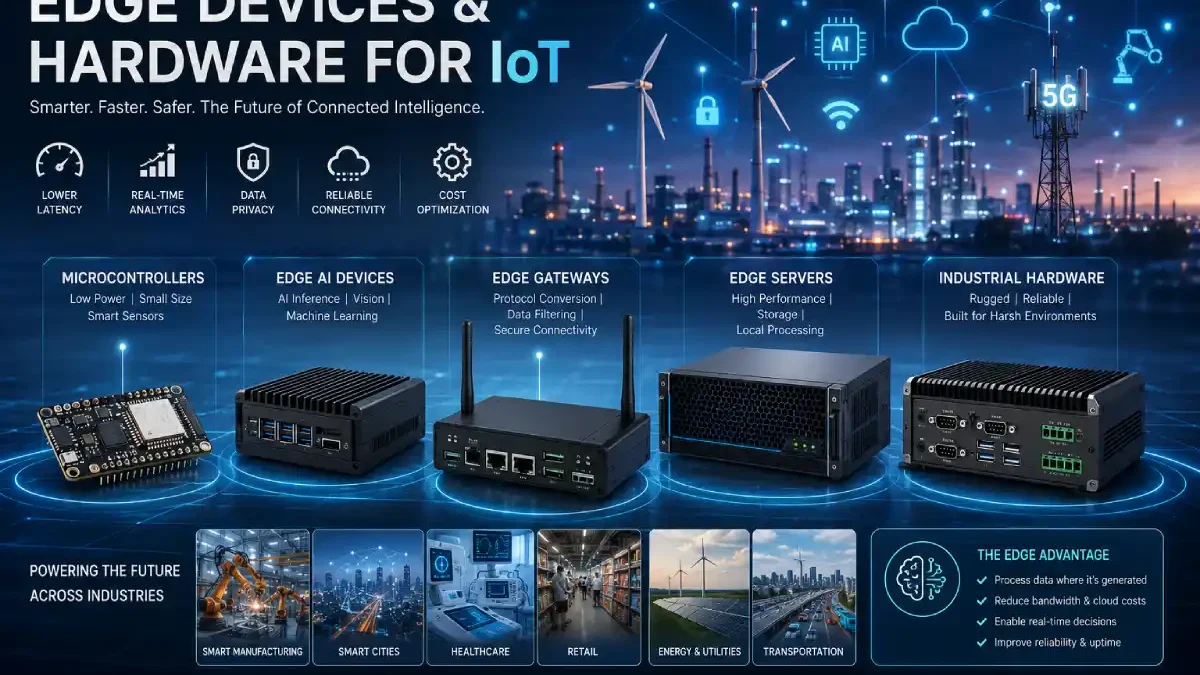
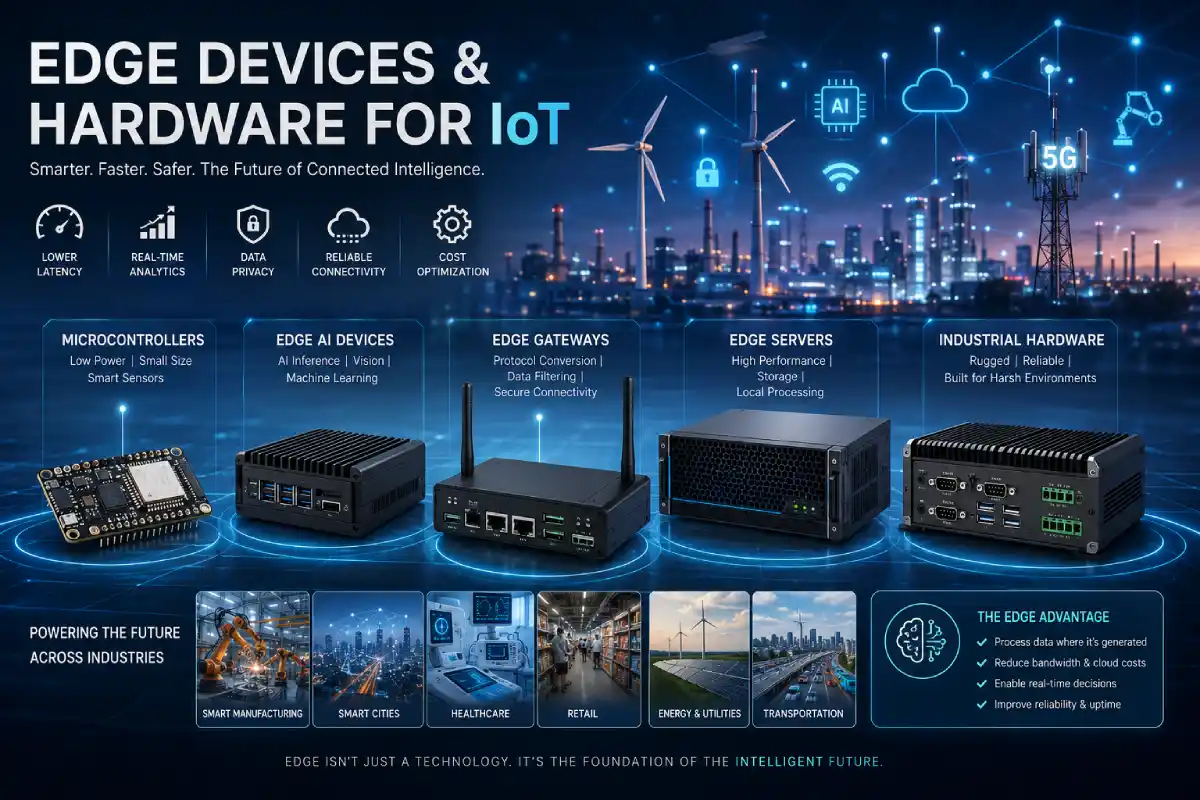
Edge Devices & Hardware for IoT – IoT becomes even more relevant if the “thinking” happens closer to the devices, sensors and humans producing the data. Edge computing as discussed by AWS IoT Greengrass and Azure IoT Edge involves local data processing and analysis for increased responsiveness and operational continuity, even when network connections to the cloud may be unavailable or unreliable.
This is where edge hardware is critical. The right kind of device enables lower latencies, decreased bandwidth, higher security and better real-time control of industrial systems while the wrong kind can result in higher power consumption, over-heating, and inadequate performance.
Table of Contents
Best Edge Devices for IoT in 2026

The “best” edge device is not necessarily the strongest. With IoT, the strongest option isn’t always the right choice. When choosing a device in an IoT setting, the smartest option should always correlate to what kind of workload, atmosphere, and price point your application can handle. A small sensor, a factory gateway, or an edge AI box all accomplish different tasks.
| Device class | Best for | Example | Why it stands out | Trade-off |
| Microcontroller | Small, intelligent sensing, control and connectivity | ESP32 | designed for connected embedded systems And industrial temperature operation ranging from -40 C to +125 C. | Minimal compute and memory |
| Compact edge computer | Protoyping, small regional apps, lightweight analytics | Raspberry Pi 5 | It sports the hexa-core, 64-bit quad-core Arm Cortex-A76 at 2.4GHz, and is available with up to 16GB of RAM. | Not for rough industrial locations unless it is extra protected |
| Edge AI device | Vision, inference, robotics, smart inspection | NVIDIA Jetson Orin Nano | NVIDIA positions Jetson as a compact edge AI platform, and the Orin Nano family offers up to 40 TOPS with 5W–15W power options. | More expensive than basic IoT boards |
| Industrial gateway | Factory connectivity, protocol translation, local data handling | Siemens SIMATIC IOT2050 | Designed to retrofit existing plants and link production, IT, and cloud without changing core hardware. | Less suitable for heavy AI workloads |
| Edge server | Multi-site aggregation, local databases, serious analytics | Lenovo ThinkEdge SE100 / SE455 | Built for edge locations; the SE100 is purpose-built for tight spaces, and Lenovo’s edge servers are aimed at edge computing, edge AI, and hybrid cloud workloads. | Higher cost and more deployment complexity |
IoT Edge Hardware Explained

IoT edge hardware is not primarily a box but rather a stack. On the lowest level is silicon itself – a microcontroller, CPU or AI accelerator. Enveloping that are firewalls, hardware security elements, power regulators, thermal design, wired/wireless interfaces, storage and memory that decide if it can withstand everyday environments.
A board like Raspberry Pi 5 is sufficient for light workloads as it balances a contemporary quad-core processor with sufficient RAM for local dashboards, camera streams, or small services. For always-on embedded sensing, ES32 class hardware appeals due to low power, Wi-Fi and Bluetooth connectivity, and rugged operating temperatures.
For heavier edge software, the hardware needs a real runtime as well. Running apps from the cloud on the Edge: Both Azure IoT Edge for deploying the containerized linux app and AWS IoT Greengrass can deploy modular components to the Edge and can speak to the cloud as needed.
Edge Computing Gateways for IoT
Gateways is many an IoT system’s middle management, collecting data from sensor, translation protocol, filter out noise and deciding what gets sent up – which is why you’ll find them all over the place from factories to utilities and on legacy industrial systems.
Siemens’ SIMATIC IOT2050 is a good example of this gateway style. Siemens says it can retrofit existing plants without replacing current hardware or software, and that it links in-company IT, production, and cloud systems while processing data from multiple sources.
Dell’s Edge Gateway 5000 Series is another strong example. Dell describes it as a device for aggregating, securing, and relaying sensor data, with local analytics that help send only meaningful information onward and reduce bandwidth use.
| Gateway option | Strong point | Best use case |
| Siemens SIMATIC IOT2050 | Easy retrofit for industrial environments | Plants that need protocol bridging and local data handling. |
| Dell Edge Gateway 5000 | Local analytics and secure sensor aggregation | Distributed sensor networks that need bandwidth savings. |
Microcontrollers for Edge IoT
Microcontrollers are the quiet workhorses of IoT. They are ideal when the job is to read a sensor, trigger an action, wake up occasionally, and stay on a tiny power budget. NXP’s Edge Verse platform and MCX portfolio are both aimed at edge and industrial IoT use, while Espressif’s ESP32 family remains a strong fit for connected embedded products.
The real advantage of a microcontroller is efficiency. However, you don’t want to run a whole edge server on a battery-powered vibration sensor or a smart thermostat; that design paradigm is the realm of the microcontroller – keeping cost, heat, and power requirements in check while still providing a decent level of local smarts for filtering, crossing thresholds, or simple control loops.
| Microcontroller choice | Why it fits edge IoT | Practical example |
| ESP32 | Wi-Fi/Bluetooth connectivity plus industrial temperature tolerance | Smart sensors, wearables, home automation, light industrial nodes. |
| NXP MCX / EdgeVerse family | Edge-focused hardware and security platform | Industrial IoT nodes that need scalable embedded processing. |
Best Edge Servers for IoT Deployments
Edge servers are for the jobs that outgrow gateways and microcontrollers. They are the right choice when you need local databases, video analytics, AI inference, or a cluster of connected devices that all need fast decisions without constant cloud round-trips. Lenovo says its Think Edge servers are built for edge computing, edge AI, hybrid cloud, and workloads at the edge locations.
The Lenovo Think Edge SE100 is especially interesting for tight spaces. Lenovo’s product guide describes it as a purpose-built server that is one-third width and significantly shorter than a traditional server, making it suitable for wall, ceiling, desk, or rack deployment. That kind of form factor is useful in branches, retail back rooms, and industrial cabinets.
Lenovo also updated Think Edge SE455 V3 and SE455i V3 product guides in 2026, which shows how quickly the edge server category is evolving toward more AI-ready deployments. Dell, meanwhile, still positions PowerEdge and edge platforms as part of its broader edge infrastructure story for IoT and bandwidth-intensive workloads.
| Edge server option | Best for | Why it matters |
| Lenovo ThinkEdge SE100 | Small edge rooms and branch deployments | Compact footprint with flexible mounting options. |
| Lenovo ThinkEdge SE455 V3 family | Higher-performance edge AI / inference | Part of Lenovo’s 2026 edge server portfolio. |
| Dell PowerEdge edge platforms | Enterprise edge environments | Built for scalable, managed edge infrastructure. |
How to Choose the Right Hardware
A simple rule works well. Use a microcontroller when the device must sip power and make small decisions. A gateway when you need protocol translation, buffering, and local filtering. Use an edge AI device when vision or inference is involved. Use an edge server when many devices, big datasets, or local analytics need serious compute and storage.
And software is as important as hardware If the devices requires resilience to be connected off-line, need to run local analytics, or need to have container based applications running then the AWS IoT Greengrass and Azure IoT Edge Platforms allow you to further add value to the hardware with its own on-edge capabilities for security, deployment and local execution.
Final Thoughts
The future of IoT is not one device category winning everything. It’s multi-tiered with microcontrollers doing the sensing, gateways translating the data, edge computers providing some local smarts, and edge servers managing the heavy lifting nearby the source of the data. That’s the design that makes IoT fast, responsive and useful in 2026.