
Last Updated: June 22, 2026
Internet of Things (IoT) Technology has certainly revolutionize our living, eating, playing, working, learning and governing. All our life experiences today like homes, wearable devices like heart monitors, tracking devices, smart kitchens, buildings, streetlights and cities have become smarter than ever. With the rapid adoption of IoT in our life, attack surfaces in the market place will only rise.
Edge security is the critical enabler to extend digital to even more remote and distributed environments.
Organizations must secure IoT devices and data not just in the cloud and the data center, but wherever they are, all the way down to sensors, gateways and edge compute devices.
Table of Contents
What Is Edge Security in IoT?

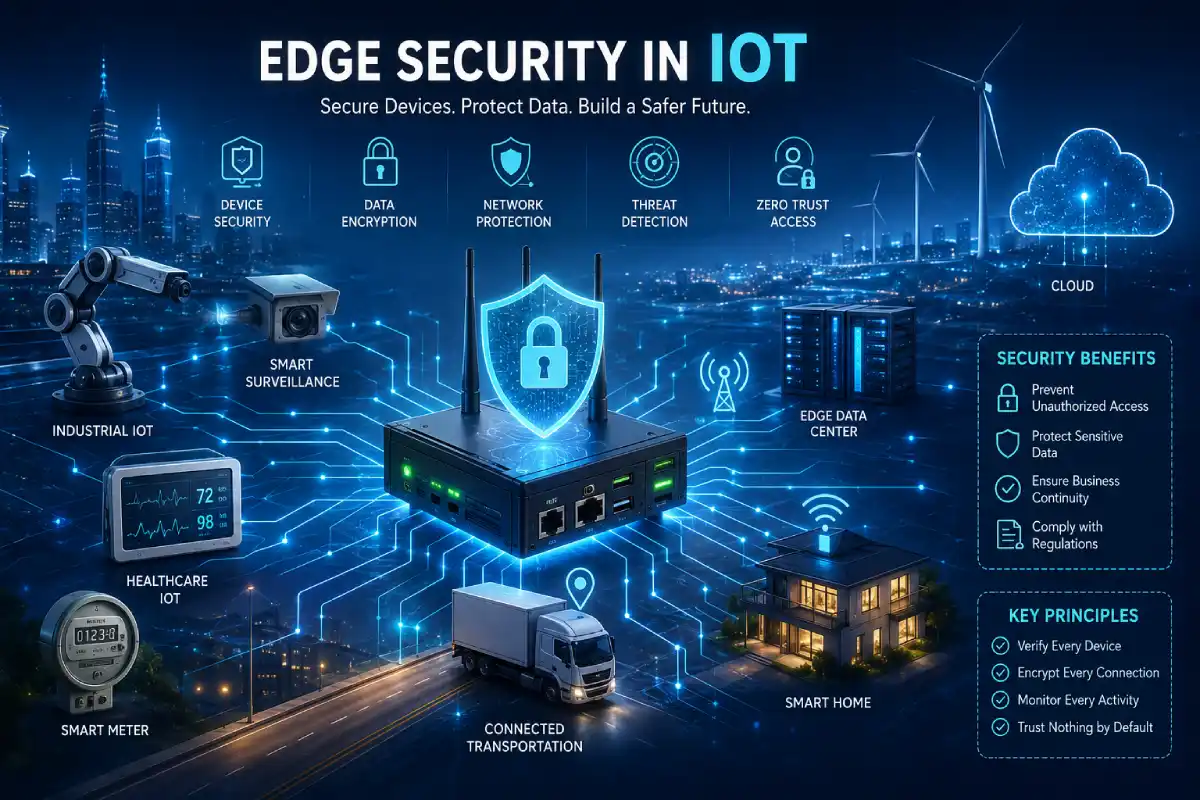
When it comes to data IoT edge security denotes everything it involves-practices, devices, policies to maintain that sensitive edge of IoT and information within that space of our network. The edge, or simply where data either goes to and from the cloud or is at storage before or as it’s generated.
In IoT, this edge may include:
- Smart sensors
- Industrial controllers
- Edge gateways
- Local AI processors
- Connected cameras
- Retail terminals
- Smart city infrastructure
Unlike traditional IT systems, IoT edge environments are often distributed, lightweight, and difficult to update. Many devices are built with limited memory, limited power, and minimal security features. That makes security planning even more important.
The main goal is to ensure three things:
- Only trusted devices can connect
- Data stays protected in transit and at rest
- Attackers cannot move freely across the network
Why Edge Security Matters in IoT
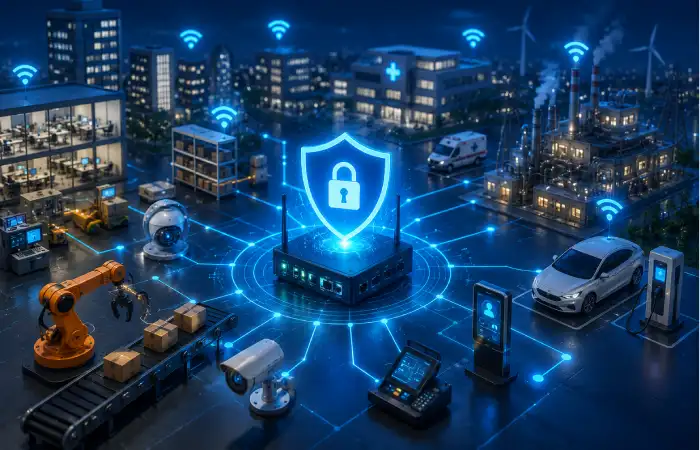
The value of IoT devices is their ability to gather data and react with a high degree of agility. While this flexibility is a key asset, it also represents one of their vulnerabilities – an exploit on one of their IoT device can mean access to a larger system.
Edge security matters because it helps prevent:
- Data theft
- Device takeover
- Operational disruption
- Privacy violations
- Ransomware spread across connected systems
- Unsafe automation in critical environments
It applies equally to a variety of different industries, including the likes of health, the factory, supply chain, energy, commerce, and smart structures. It does not need a security breach to turn into a business risk – it could be a company, security risk or a matter of compliance at one point.
Common Edge IoT Security Threats
In reality, these threats could be of myriad variety, and could span anything from rather basic attacks to those that are incredibly targeted. Most prevalent are those that target weak credentials, compromised hardware through stale firmware, unsafe communications, or ineffective access control.
Common Threats Table
| Threat | What Happens | Risk Level | Typical Impact |
| Weak passwords | Attackers guess or steal login details | High | Device takeover |
| Unpatched firmware | Known flaws remain open | High | Remote exploitation |
| Data interception | Traffic is captured in transit | High | Privacy and credential leaks |
| Malware injection | Malicious code enters the device or gateway | High | Network spread |
| Device spoofing | Fake device pretends to be trusted | Medium | Unauthorized access |
| Physical tampering | Someone accesses the hardware directly | Medium | Data theft or sabotage |
| DDoS attacks | Devices or gateways get overwhelmed | High | Service outage |
| Insider misuse | Authorized users abuse access | Medium | Data loss or sabotage |
Most frequent security gaps
- Default credentials left unchanged
- No device identity verification
- Insecure APIs
- Weak segmentation between devices
- Poor logging and monitoring
- Missing update process
- No encryption for sensitive traffic
When these gaps combine, the edge becomes a soft target.
Edge Computing Cybersecurity
Edge computing security refers to systems used to secure the processors of the location close to data.
In IoT terms; is ensuring the local devices, devices and intermediate level to the edge securely protected.
The edge’s allure stems from a basic premise: It typically lacks the elaborate security mechanisms employed in centralized cloud instances. Systems built with expediency and high performance may sacrifice security, at times sacrificing extensively.
A strong edge cybersecurity strategy should cover:
- Identity and authentication
- Secure boot and firmware integrity
- Data encryption
- Network segmentation
- Threat detection
- Access logging
- Patch management
- Incident response
The edge should not be treated as “small cloud.” It needs its own security design because the environment is different. Devices may be remote, unmanned, resource-limited, and spread across many physical locations.
Securing IoT Edge Devices
IoT edge devices are almost always the weakest link in an IoT system. Thousands can be installed and then ignored until they’re years old and long overdue for a patch or are being used by invaders.
Securing Devices Table
| Security Control | Purpose | Why It Helps |
| Unique device identity | Confirms each device is real | Stops impersonation |
| Strong authentication | Verifies device and user access | Reduces unauthorized access |
| Secure boot | Ensures trusted firmware loads first | Prevents tampered software |
| Firmware signing | Confirms update authenticity | Blocks malicious updates |
| Encryption | Protects data in transit and storage | Reduces interception risk |
| Least privilege | Limits what each device can do | Contains damage if compromised |
| Regular patching | Fixes known vulnerabilities | Closes attack paths |
| Device monitoring | Tracks unusual behavior | Detects early threats |
Good device security habits
Device security should start from day one, even before powering up your IoT devices. Unique credentials for each device, secure communication configurations, and an effective upgrade strategy should be on your list. For example, passwords should never be used on multiple devices.
An easy best practice is simply cutting unneeded services: The less ports that are opened, the less unneeded functionality the device or service provides and the less attack surface you have exposed.
You can also consider adding device tamper protection. This might involve alarming a system any time a device is opened or moved in sensitive environments.
IoT Edge Security Best Practices
This is where security becomes practical. The best approach is not one single tool, but a layered defense model.
Best Practices Table
| Best Practice | What It Does | Priority |
| Use device certificates | Confirms trusted identity | Very High |
| Encrypt all traffic | Protects data in motion | Very High |
| Segment networks | Separates devices by risk level | Very High |
| Apply least privilege | Restricts unnecessary access | High |
| Keep firmware updated | Fixes vulnerabilities | Very High |
| Monitor logs continuously | Detects suspicious activity | High |
| Disable unused services | Reduces attack surface | High |
| Plan incident response | Speeds recovery after an attack | High |
Simple security rules that work well
- Never deploy a device with default admin credentials
- Update firmware on a fixed schedule
- Isolate critical devices from guest or public networks
- Require authentication before any remote access
- Log all device activity and review alerts regularly
- Use secure APIs with token-based access
- Rotate keys and certificates when devices are retired or reassigned
These steps are not flashy, but they are effective. Most major security failures start with basic mistakes.
Zero Trust for IoT Edge Networks
Zero Trust has become one of the strongest modern security approaches, and it fits IoT edge networks very well.
The basic premise of it: Do not trust by default-even from within the network- and ensure all device, users, and connections can be validated for access to a specific resource.
Zero Trust in practice
In an IoT edge setup, Zero Trust usually means:
- Every device is authenticated
- Every request is verified
- Access is granted only when needed
- Devices are continuously monitored
- Compromised endpoints are isolated quickly
Why Zero Trust is useful for IoT
IoT environments are highly distributed. Some devices are in factories, some in vehicles, some in hospitals, and some in remote public spaces. That makes traditional perimeter security weak.
The benefit of Zero Trust, is that it doesn’t assume local to be implicitly safe. A device could exist on the network, but still be considered untrusted until it’s verified.
Zero Trust comparison
| Traditional Model | Zero Trust Model |
| Trusts internal network by default | Verifies every request |
| Large implicit access zones | Small controlled access zones |
| Hard to detect lateral movement | Easier to isolate attackers |
| Focuses on perimeter defense | Focuses on identity and behavior |
| Weak for distributed IoT | Better fit for edge environments |
Zero Trust is not a product. It is a security mindset. When applied properly, it makes edge IoT networks much harder to exploit.
Edge Security Architecture for IoT
A strong architecture usually includes several layers of protection working together.
Security Layers Table
| Layer | Main Function | Example Controls |
| Device layer | Protect individual endpoints | Secure boot, authentication, firmware signing |
| Network layer | Control data movement | Segmentation, VPNs, firewalls |
| Edge processing layer | Protect local compute nodes | Access control, runtime monitoring |
| Application layer | Secure software services | API security, input validation |
| Data layer | Protect stored information | Encryption, backup, retention policy |
| Monitoring layer | Detect threats | SIEM, alerts, anomaly detection |
The key idea is defense in depth. If one layer fails, the next layer should still slow down the attacker.
Challenges in Edge IoT Security
Even with good planning, securing IoT at the edge is not easy. Organizations often face the following challenges:
- Large device volume
- Remote or hard-to-reach deployments
- Limited processing power on devices
- Inconsistent vendor support
- Legacy hardware that cannot be updated easily
- Poor visibility across distributed environments
- Security teams that are understaffed
These challenges explain why edge security cannot be an afterthought. It must be built into the design from the start.
Future of Edge Security in IoT
IoT is going to get more intelligent, but at the edge. IoT devices will handle more data at local locations to make decisions quickly without always depending on the cloud. All of this is going to improve response times and efficiency, but not without raising security levels as well.
We can expect to see more:
- AI-powered threat detection at the edge
- Hardware-based trust mechanisms
- Automated patching systems
- Stronger identity frameworks
- Policy-driven access control
- Zero Trust adoption in industrial IoT
Security will become intrinsic to device lifecycle, not just to the network layer of security. Those organizations which foresight will have a definite head start
Final Thoughts
Edge Security is Essential for IoT. Whether in manufacturing or citywide systems, as our connected devices gain intelligence, they also become potential vulnerable points that can allow for anything from data loss to system outages and beyond. However, with multiple points of failure, we also stand to gain resilience by leveraging the best defense: a layered approach. It means securing device-level credentials, defending the networks that connect them, ensuring every individual is validated, overseeing all traffic and communications, and keeping every component up-to-date.