
Last Updated: September 26, 2026
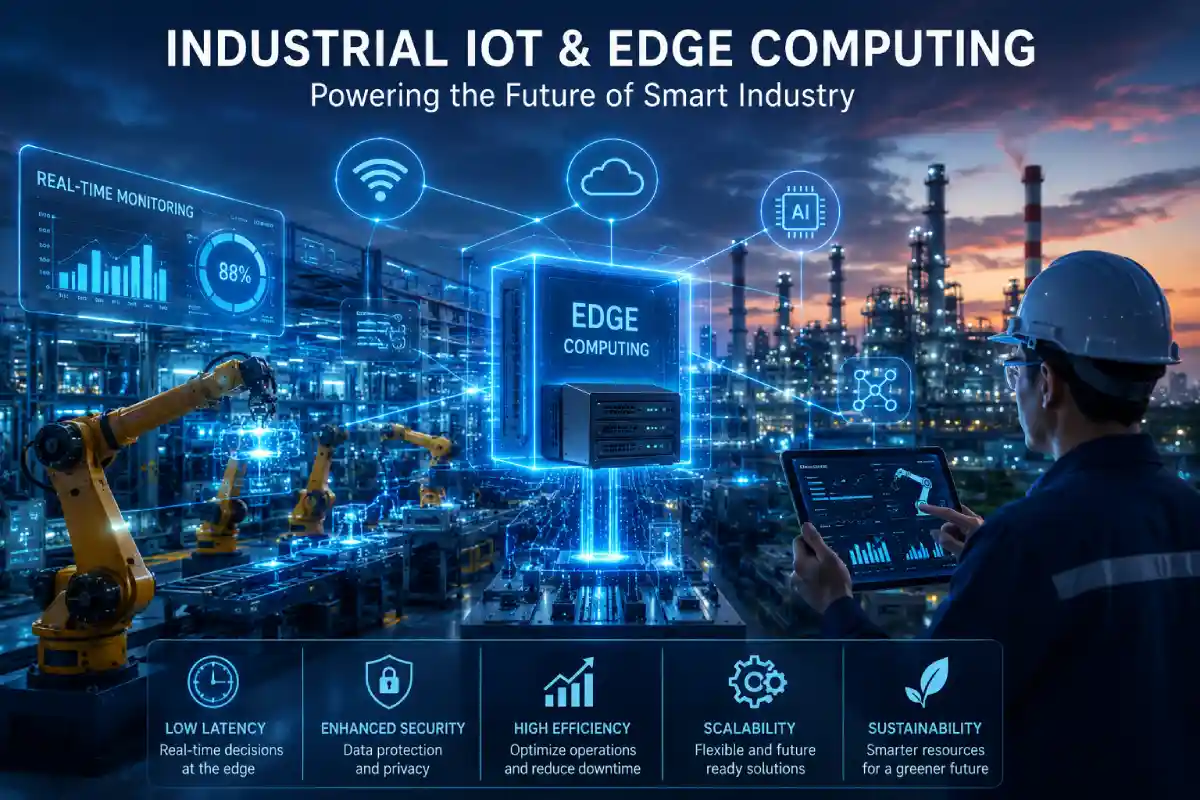
The digital transformation trend currently dominates the entire industrial world. Modern factories, energy power plants, manufacturing facilities and warehouses are becoming “smarter” with the help of Industrial Internet of Things (IIoT) and Edge computing, processing and analyzing in real-time huge quantities of data to increase operational efficiency, reduce production downtime and costs. Industrial Internet of Things (IIoT) is becoming more important, especially considering real time processing needed in industrial sector.
As such traditional cloud solutions alone seem not to cover all requirements where each second can count to make instant decisions.
In this context, Edge computing proves crucial, processing data closer to devices and machines, without depending of cloud communication. In this guide we shall cover Industrial IoT and Edge Computing, their usage together, use cases, predictions on preventive maintenance, and edge solutions used in Industry 4.0.
This article belongs to Industrial IoT
Table of Contents
Industrial IoT Edge Computing
Industrial IoT (IIoT): These are systems of industrial devices, sensors, machines, sensors and equipment that enable industrial processes and operational data to communicate. They’re also connected so the data can travel back. Edge Computing: Industrial systems don’t always need to send all of their operational data back to central cloud servers, and edge computing offers solutions for that.
How IIoT and Edge Computing Work Together
| Component | Function |
| Sensors | Collect machine and environmental data |
| Edge Devices | Process data locally |
| Gateways | Connect industrial assets to networks |
| Cloud Platform | Long-term storage and analytics |
| AI Models | Generate insights and predictions |
| Dashboards | Visualize operational metrics |
Industrial Data Flow
- Sensors gather operational data.
- Edge devices analyze information instantly.
- Critical decisions occur locally.
- Important data is transmitted to the cloud.
- AI systems identify trends and anomalies.
This architecture significantly reduces latency while improving operational reliability.
Why Edge Computing Matters in Industrial Environments
Industrial operations generate enormous amounts of data every second.
Common Challenges Without Edge Computing
| Challenge | Impact |
| High latency | Delayed decision-making |
| Bandwidth costs | Increased network expenses |
| Cloud dependency | Operational interruptions |
| Security risks | More attack surfaces |
| Data overload | Inefficient processing |
Benefits of Edge Computing
- Real-time analytics
- Faster response times
- Reduced cloud traffic
- Enhanced cybersecurity
- Improved equipment reliability
- Better scalability
- Lower operational costs
Edge computing empowers organizations with instant responses to anomaly identification for mission critical industrial systems
Edge Computing in Manufacturing
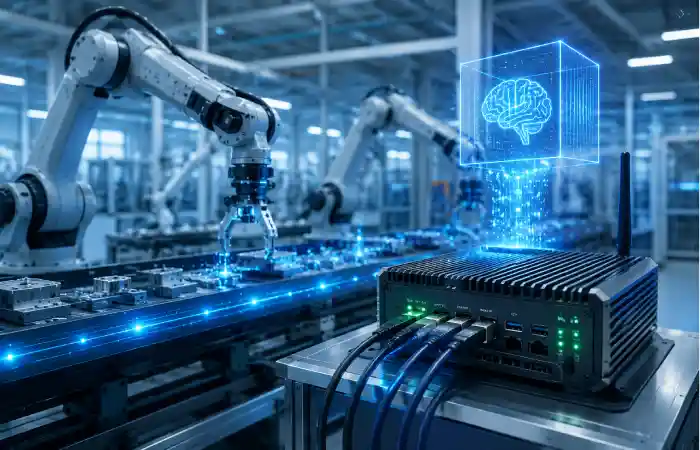
Manufacturing leads the pack for Industrial IoT & Edge Computing adoption.
A modern factory can connect thousands of sensors and device to monitor production workflows, machine performance, quality and safety, etc.
Smart Factory Architecture
| Layer | Purpose |
| Device Layer | Sensors, PLCs, machines |
| Edge Layer | Local processing and analytics |
| Network Layer | Connectivity infrastructure |
| Cloud Layer | Enterprise analytics |
| Business Layer | ERP, MES, SCM integration |
Manufacturing Benefits
1. Reduced Downtime
Maintenance departments have the advantage of receiving advance warning that something isn’t right, allowing their teams to act to address the issue before anything actually goes wrong.
2. Improved Quality Control
Edge powered computer vision systems check goods in real time for quality and find defect instantly.
3. Faster Production Decisions
Production managers receive insights instantly without waiting for cloud processing.
4. Enhanced Worker Safety
Safety sensors inspect for unsafe conditions and alert personnel when such risks are found.
Traditional Manufacturing vs Smart Manufacturing
| Feature | Traditional Factory | Smart Factory |
| Monitoring | Manual | Automated |
| Maintenance | Reactive | Predictive |
| Quality Checks | Sampling-based | Real-time |
| Data Processing | Centralized | Edge-enabled |
| Downtime | Higher | Lower |
| Productivity | Moderate | High |
Worldwide organizations are gradually moving towards “Smart Factories” in a quest for increased performance and competitiveness.
IIoT Edge Use Cases
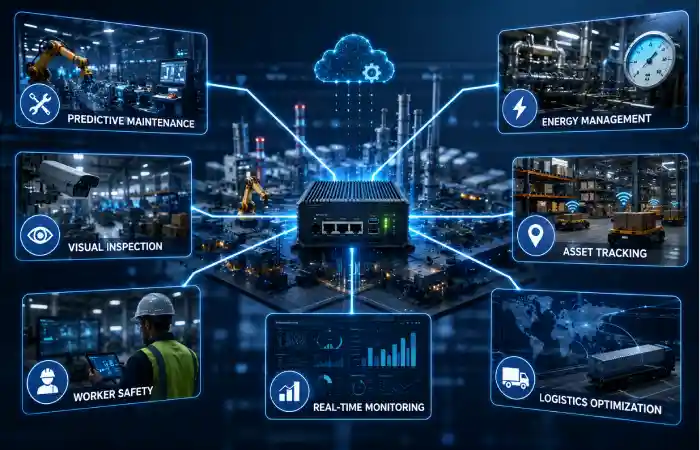
Industrial IoT and Edge Computing support numerous applications across industries.
1. Predictive Maintenance
Sensors monitor vibration, temperature, pressure, and machine performance.
Edge systems analyze the data locally and identify early warning signs of equipment failure.
Benefits
- Reduced downtime
- Lower maintenance costs
- Increased equipment lifespan
2. Real-Time Quality Inspection
Factories employ AI-enabled camera devices at production line workstations for product inspection.
Applications
- Surface defect detection
- Packaging verification
- Assembly validation
Advantages
- Faster inspections
- Higher accuracy
- Reduced waste
3. Energy Management
Industrial facilities consume significant amounts of energy.
Edge platforms monitor:
- Power consumption
- Voltage fluctuations
- Equipment efficiency
Results
| Metric | Improvement |
| Energy Costs | Reduced |
| Carbon Footprint | Lower |
| Resource Utilization | Improved |
4. Supply Chain Optimization
Edge computing enables real-time tracking of assets, shipments, and inventory levels.
Key Benefits
- Better inventory accuracy
- Reduced stock shortages
- Improved logistics visibility
5. Worker Safety Monitoring
Wearable sensors and industrial monitoring systems can detect:
- Fatigue
- Hazardous gases
- Unsafe temperatures
- Restricted area access
This creates safer work environments and minimizes workplace incidents.
6. Autonomous Industrial Operations
Industrial robots utilize edge computing for decision-making.
Examples
- Autonomous forklifts
- Warehouse robots
- Collaborative robots (Cobots)
Low-latency edge processing ensures smooth and safe operation.
Predictive Maintenance with Edge AI
Predictive maintenance is another huge benefit from this industry 4 0 technology. If it’s not necessary to have another breakdown on the line we’re losing money; and if our repairs are not adequate to predict our downtime we’re still losing money on other equipment.
Edge AI will start taking the pressure off from there; as it starts analyzing its own equipment condition.
Maintenance Approaches Comparison
| Maintenance Type | Description | Efficiency |
| Reactive | Repair after failure | Low |
| Preventive | Scheduled maintenance | Moderate |
| Predictive | AI-driven maintenance | High |
How Edge AI Enables Predictive Maintenance
1: Data Collection
Sensors gather:
- Temperature
- Vibration
- Noise levels
- Pressure
- RPM
2: Edge Processing
Edge devices process sensor data instantly.
3: AI Analysis
Detecting abnormal machine learning patterns
4: Failure Prediction
Potential equipment failures can be detected before they occur.
5: Maintenance Scheduling
Alert and advice can be sent to maintenance teams
Benefits of Predictive Maintenance
| Benefit | Impact |
| Reduced Downtime | Significant |
| Lower Repair Costs | High |
| Better Asset Utilization | Improved |
| Increased Productivity | Higher |
| Longer Equipment Life | Extended |
Example Scenario
A factory production motor starts to develop some unusual vibration patterns.
The edge AI system detects the impending problem in time before it results in a catastrophic failure and then automatically notifies the maintenance crew that something needs attention on the production floor.
Maintenance can get to the motor and repair it during periods when it wasn’t running anyway, without losing money on production costs, potentially saving organizations many millions every year.
Best Edge Solutions for Industry 4.0
Organizations undergoing this Industry 4.0 implementation need solid infrastructure on the edge. The choice here is dictated by the industry’s requirements, but also needs to include considerations for scalability, security, and the kind of data processing the applications will require.
Leading Edge Computing Technologies
| Solution Type | Primary Purpose |
| Industrial Edge Gateways | Data aggregation |
| AI Edge Devices | Local AI processing |
| Edge Servers | Advanced analytics |
| Micro Data Centers | Distributed computing |
| Edge Cloud Platforms | Hybrid processing |
Key Features to Consider
Scalability
Industrial environments continuously expand. Edge platforms should support future growth.
Security
Industrial cybersecurity is critical.
Important security features include:
- Encryption
- Secure boot
- Zero-trust architecture
- Threat detection
AI Integration
Modern edge platforms should support:
- Machine learning
- Computer vision
- Deep learning inference
Reliability
Industrial environments require:
- High availability
- Rugged hardware
- Fault tolerance
Edge Computing Vendor Evaluation Framework
| Criteria | Importance |
| Performance | High |
| Security | High |
| Scalability | High |
| AI Support | Medium |
| Cost Efficiency | Medium |
| Cloud Integration | High |
Businesses need to ensure that a vendor is considered from the operational needs as well as future-vision of Digital transformation of business.
Future Trends in Industrial IoT & Edge Computing
The future of Industry 4.0 will be driven by several emerging technologies.
Edge AI Expansion
More AI models will run directly on edge devices.
2. Digital Twins
Virtual replicas of industrial systems will enable advanced simulation and optimization.
3. 5G Connectivity
Ultra-low latency networks will enhance industrial automation.
4. Autonomous Factories
Factories will increasingly operate with minimal human intervention.
5. Sustainable Manufacturing
Reduced waste and energy usage with edge analytics.
6. Hyper-Automation
With an integration of Artificial intelligence, Robotics, IIoT and Edge computing will lead to autonomous inudstrial ecosystems.
Key Advantages of Industrial IoT & Edge Computing
| Advantage | Business Value |
| Real-Time Analytics | Faster decisions |
| Lower Latency | Immediate responses |
| Reduced Downtime | Higher productivity |
| Predictive Maintenance | Lower costs |
| Enhanced Security | Better protection |
| Improved Quality | Reduced defects |
| Energy Optimization | Sustainability gains |
| Scalability | Future-ready infrastructure |
Conclusion
IIoT and edge are transforming manufacturing IIoT and Edge Computing are altering the way factories and industrial enterprises operate. By bringing compute closer to machines, these devices can analyze industrial IoT data in real-time, enhance efficiency, guarantee security and provide higher earnings. Industrial IoT has emerged as the next generation for manufacturing, supporting smart maintenance and repair, automated testing of quality, autonomous robots, power consumption and much more. As AI, IoT, the Internet 5G.