
Last Updated: September 23, 2026
Technology startups are transforming the way people work, communicate, shop, travel, learn, and do business. From artificial intelligence and automation to fintech, health technology, cloud computing, cybersecurity, and Internet of Things solutions, new companies are constantly introducing products and services that address changing customer needs.
For entrepreneurs, investors, technology professionals, and curious readers, understanding technology startup ideas and innovation can provide valuable insight into where the digital economy is heading.
This guide explores technology startups, startup ideas, innovation, business models, funding, emerging technologies, entrepreneurial strategies, and the trends shaping the future of technology companies.
This article belongs to Startups
Table of Contents
What Are Technology Startups?
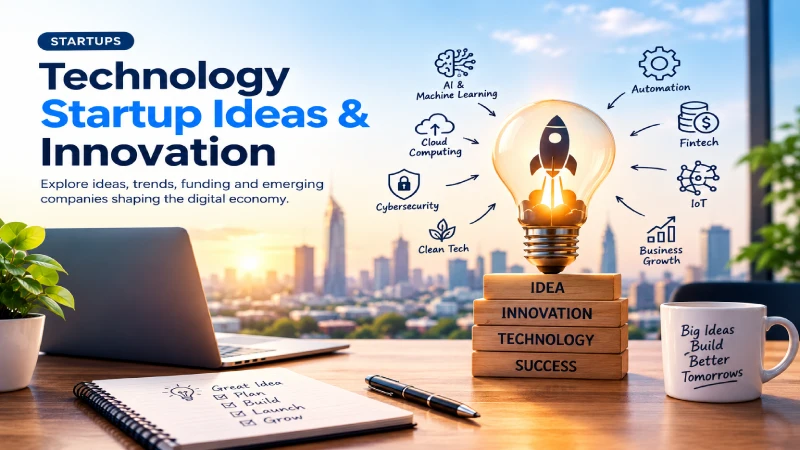
A technology startup is a relatively new company that uses technology to develop a product, service, platform, or business model designed to solve a particular problem or serve an emerging market.
Unlike traditional businesses, technology startups often aim to use software, digital platforms, data, automation, or emerging technologies to create solutions that can scale rapidly.
Examples include startups developing:
- Artificial intelligence applications
- Business automation platforms
- Financial technology solutions
- Cybersecurity products
- Cloud software
- E-commerce platforms
- Health technology
- Educational technology
- Internet of Things solutions
- Robotics and automation
- Developer tools
- Enterprise software
- Clean technology
- Digital collaboration tools
The startup ecosystem continues to evolve as entrepreneurs identify new problems and combine technology with creative business models.
Why Technology Startup Ideas Matter
Successful startups usually begin with a problem rather than simply a technology.
An entrepreneur may notice that businesses spend too much time performing repetitive tasks, consumers struggle with an existing service, or organizations need better ways to manage information. A startup can then develop a technology-based solution to address that problem.
This makes identifying useful technology startup ideas and innovation an important part of entrepreneurship.
A strong startup idea typically has several characteristics:
- It solves a real problem.
- There is a clearly identifiable customer.
- The solution provides measurable value.
- Technology can improve the existing process.
- The business has potential to scale.
- Customers are willing to pay for the solution.
An innovative idea does not necessarily have to introduce technology that has never existed before. Innovation can also involve applying existing technology in a new industry, improving an inefficient process, or creating a better customer experience.
Technology Startup Ideas to Explore
The technology startup landscape contains opportunities across many industries. Entrepreneurs can explore established technology markets as well as emerging areas where customer needs are still developing.
Artificial Intelligence Startups
Artificial intelligence is creating opportunities for startups across almost every sector.
Potential startup concepts include AI-powered customer support, document processing, business intelligence, content workflows, personalized education, developer tools, research assistants, and industry-specific AI software.
Rather than building a general-purpose AI product, startups can focus on specific industries or workflows where specialized solutions can provide practical value.
Business Automation Startups
Businesses increasingly want to reduce repetitive manual work.
Automation startups can help companies automate tasks such as data entry, customer communication, reporting, scheduling, document management, workflow approvals, and internal operations.
This category can be particularly attractive for entrepreneurs because businesses can often measure the value of automation through saved time, reduced operational costs, or improved productivity.
Fintech Startups
Financial technology startups use digital technology to improve financial products and services.
Potential areas include digital payments, accounting software, financial management tools, fraud detection, lending technology, financial education, and business finance platforms.
Fintech entrepreneurs must also consider regulatory requirements, security, privacy, and customer trust.
Cybersecurity Startups
As businesses move more operations online, cybersecurity remains an important technology market.
Startups can develop solutions for identity management, cloud security, threat monitoring, employee security awareness, data protection, application security, and automated security operations.
Cybersecurity products can serve consumers, small businesses, large enterprises, or specialized industries.
Internet of Things Startups
Internet of Things technology connects physical devices to networks and software systems.
Startup opportunities include smart buildings, industrial monitoring, connected equipment, energy management, logistics tracking, agriculture technology, and smart home solutions.
The combination of sensors, connectivity, cloud platforms, and analytics allows startups to create technology products that connect the physical and digital worlds.
Emerging Technology and Startup Opportunities
Emerging technologies frequently create new opportunities for entrepreneurs.
Artificial intelligence, robotics, edge computing, quantum computing, blockchain, extended reality, advanced connectivity, and other technologies can introduce new possibilities for businesses.
However, entrepreneurs should distinguish between technology that is interesting and technology that solves a valuable problem.
A technology can receive significant attention without immediately producing a sustainable business opportunity. Successful founders therefore need to evaluate customer demand, technical feasibility, competition, costs, regulations, and potential revenue.
This approach makes technology startup ideas and innovation more practical: the objective is not simply to follow the newest technology trend but to understand how technology can create useful products and services.
How to Find a Good Startup Idea
Finding a startup idea can begin with everyday problems.
Entrepreneurs can look at their own industries, workplaces, communities, and online experiences to identify processes that are expensive, slow, confusing, inconvenient, or outdated.
A useful process is:
1. Identify a Problem
Start by identifying a specific problem experienced by a specific group of people.
2. Research Existing Solutions
Look at competitors and existing alternatives. Understanding what already exists helps determine whether there is room for improvement.
For additional guidance on researching your market and evaluating competitors, see the U.S. Small Business Administration’s business planning guide. The guide covers market research, competitive analysis, business planning, startup costs, and funding.
3. Talk to Potential Customers
Customer conversations can reveal whether the problem is significant enough for people or businesses to pay for a solution.
4. Develop a Simple Solution
Instead of immediately building a complex product, create a minimum viable product that tests the core idea.
5. Measure Customer Response
Feedback, usage, retention, and willingness to pay can provide valuable evidence about whether the concept deserves further development.
6. Improve and Scale
Once the product demonstrates demand, the startup can improve its technology, expand its customer base, hire employees, and explore additional markets.
Startup Innovation and Business Models
Innovation is closely connected to business models.
A technology startup may generate revenue through subscriptions, transaction fees, advertising, licensing, usage-based pricing, marketplaces, enterprise contracts, or a combination of several models.
Software-as-a-Service, commonly called SaaS, is one example of a technology business model in which customers pay recurring fees to access software.
Marketplaces can connect buyers and sellers and generate revenue through transaction fees. Fintech companies may earn through service fees or financial products, while enterprise technology companies may use annual contracts.
Choosing a business model should depend on the product, customers, market structure, and value delivered.
Startup Funding and Investment
Funding is another important part of the startup ecosystem.
Technology companies can finance their early development through bootstrapping, revenue, friends and family, angel investors, venture capital, accelerators, grants, crowdfunding, or strategic partnerships.
Not every startup needs venture capital. Some businesses can grow sustainably through customer revenue, while others require substantial investment because they need expensive research, infrastructure, hardware, or rapid international expansion.
Founders should understand how different funding approaches affect ownership, growth expectations, financial risk, and decision-making.
What Investors Look for in Technology Startups
Investors may evaluate several aspects of a technology startup before providing funding.
These can include:
- Market size
- Customer demand
- Product differentiation
- Revenue potential
- Growth rate
- Competitive landscape
- Technology and intellectual property
- Business model
- Founder and management team
- Customer retention
- Financial performance
- Scalability
Different investors have different strategies and criteria, so there is no single formula for obtaining startup funding.
Challenges Faced by Technology Startups
Building a startup is rarely straightforward.
Technology companies can face challenges involving product development, competition, hiring, cybersecurity, funding, regulations, customer acquisition, infrastructure costs, and changing technology.
One common challenge is building a product before fully understanding customer needs. Another is attempting to grow too quickly without establishing a sustainable business model.
Startups must also adapt as markets change. A technology that appears promising today may evolve rapidly, creating both opportunities and competitive pressure.
The Role of Innovation in Startup Growth
Innovation is not limited to creating new technology.
A startup can innovate through its product, customer experience, distribution strategy, pricing model, internal processes, or business model.
For example, an established technology can become innovative when applied to an industry that has not previously adopted it effectively.
Continuous innovation can also help startups respond to customer feedback and competitive changes.
The strongest companies often treat innovation as an ongoing process rather than a single event that happens during product creation.
Technology Startup Trends to Watch
Several areas are likely to remain important to the startup ecosystem as technology adoption continues to develop.
These include:
- Artificial intelligence and AI-powered software
- Business process automation
- Cybersecurity and digital identity
- Cloud computing
- Edge computing
- Internet of Things
- Robotics
- Fintech
- Health technology
- Climate and clean technology
- Developer platforms
- Enterprise software
- Data analytics
- Digital commerce
- Advanced computing
The significance of each trend will depend on customer adoption, technological progress, economic conditions, regulation, and the ability of companies to turn technical capabilities into sustainable products.
How Entrepreneurs Can Build for the Future
Entrepreneurs exploring technology startup ideas and innovation should focus on the intersection of technology, customer needs, and business value.
Instead of asking only, “What new technology can I build?” a better starting point is:
“What problem can technology solve better, faster, cheaper, or more conveniently?”
This question can help founders discover opportunities in both established and emerging markets.
Entrepreneurs should also develop strong research habits. Studying competitors, interviewing customers, monitoring technology developments, testing assumptions, and measuring results can reduce unnecessary risk.
A startup does not need to predict the future perfectly. It needs to understand its customers and continuously adapt to changing circumstances.
Frequently Asked Questions About Technology Startups
What is a technology startup?
A technology startup is a new company that uses technology to create a product, service, platform, or business model designed to solve a problem or serve a market.
What are some technology startup ideas?
Popular areas include artificial intelligence, business automation, cybersecurity, fintech, cloud software, IoT, robotics, health technology, education technology, and data analytics.
How do I find a technology startup idea?
Look for problems that affect a specific group of customers and investigate whether technology can provide a significantly better solution. Customer interviews and competitor research can help validate the opportunity.
Do all technology startups need investors?
No. Some startups can grow through revenue and bootstrapping, while others seek angel investment, venture capital, grants, or other funding because of their growth and capital requirements.
What makes a startup innovative?
Innovation can come from a new technology, a better product, a new business model, a more efficient process, or a significantly improved customer experience.
Final Thoughts
The world of technology startups continues to expand as entrepreneurs discover new ways to apply digital technologies to real-world problems. From AI and automation to cybersecurity, fintech, IoT, cloud computing, and emerging technologies, opportunities exist across a wide range of industries.
Understanding technology startup ideas and innovation requires looking beyond individual technologies. The most useful opportunities often emerge where a genuine customer problem meets a practical technological solution and a sustainable business model.
Whether you are researching startup opportunities, exploring entrepreneurial ideas, following funding trends, or simply interested in companies shaping the digital economy, the technology startup ecosystem offers a constantly changing landscape to explore.
This pillar page can serve as a starting point for discovering startup ideas, innovation trends, emerging companies, funding concepts, business models, and the technologies that may influence the next generation of digital businesses.