

Last Updated: June 25, 2026
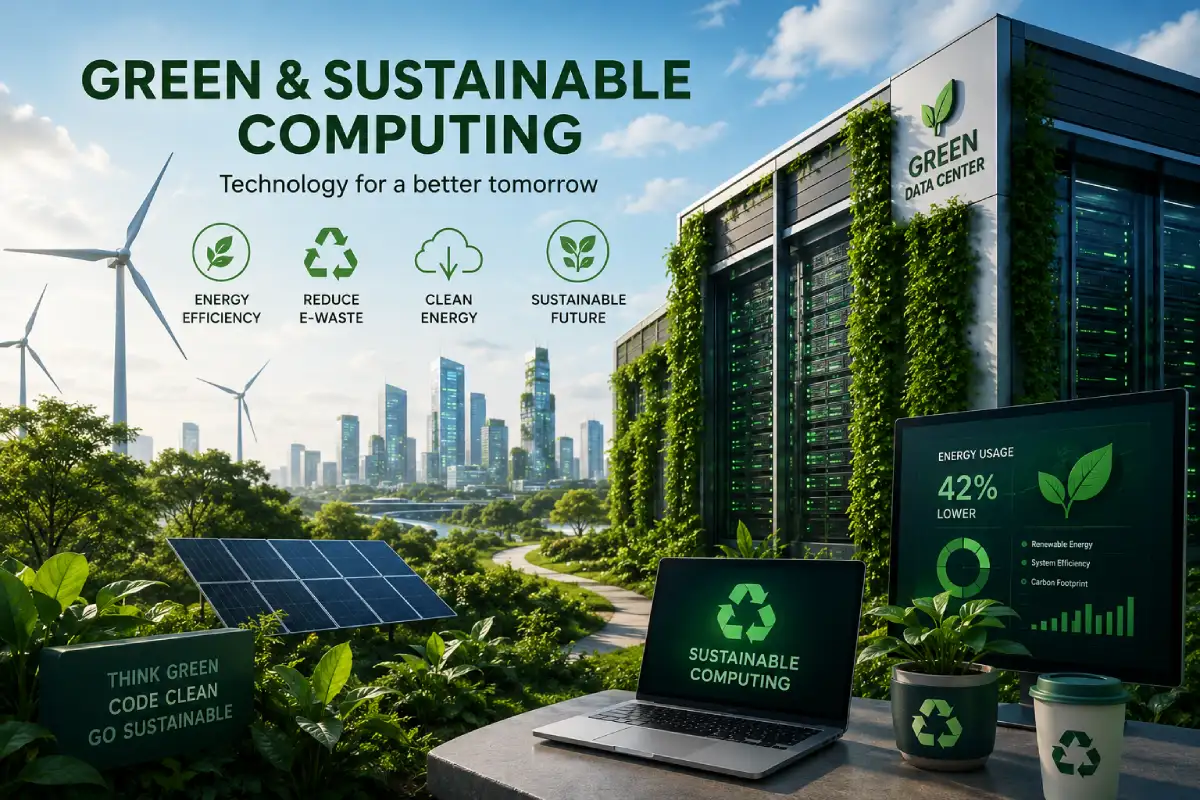
Green & Sustainable Computing – We are starting to see huge implications from cloud, AI, and systems that are on all the time – for how much energy our data centers and devices use, how much they need cooling, and for hardware waste.” An article from the International Energy Agency highlights that the group is already modeling the increased demand for power as artificial intelligence gains steam; at the same time, the U.S.
EPA is identifying data centers as still having huge efficiency gains in usage.
But “there’s actually opportunity here; it’s about designing systems so that they do more with less. Less power, less heat, less material waste, less carbon,” says Microsoft. Sure, players such as Dell, HP, AMD, Microsoft, Intel, and Google have stood up and made declarations on sustainability with things like building products from recycled materials, green data centers, renewable-energy purchase, energy-efficient silicon.
Table of Contents
What is Green Computing

Green computing means to design, make, use and dispose off all of the resources associated with the technology and minimizing the environmental effect over its lifecycle. It basically pose a question in practical world – How to get same compute effect with lesser energy consumption and carbon footprint? This means energy-saving computers, efficient software and hardware, increased longevity, better cooling and efficient disposal.
Green computing has to be considered as a strategy and in that – decreased power consumption has great financial implications as well through electricity and performance will increase per watt by better hardware designs, according to Intel, they reduce the environmental impact through minimizing their footprint and increasing their overall efficiency.
AMD claim that they reduce green house gas and overall usage of power along the entire value chain through environmental programmes.
Traditional Computing vs Green Computing
| Aspect | Traditional Approach | Green Computing Approach |
| Hardware choice | Focus on raw power only | Focus on performance per watt |
| Cooling | Often energy-heavy | Uses optimized airflow, liquid cooling, and heat reuse |
| Lifecycle | Replace fast, recycle late | Repair, reuse, and extend product life |
| Data center strategy | Scale first, optimize later | Optimize workload placement and energy use from the start |
| Waste management | Limited circularity | Recycled materials, modular parts, and responsible recovery |
The difference is huge since all computing is moving beyond a personal computer – this will involve cloud, AI,edge and huge all-day data centres that are packed with computers – which is where tiny gains become big economies.
Sustainable Data Center Innovations
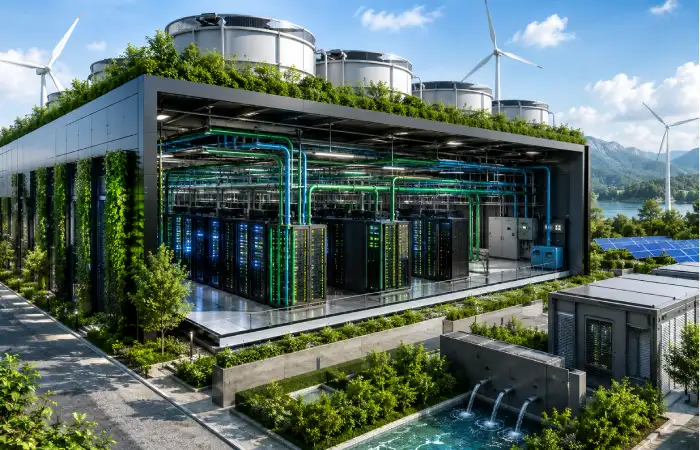
Much of the green computing talk has been centered around the facilities that form the backbone of cloud storage, streaming media, AI and enterprise computing, data centers. While data centers “consume energy and water,” according to Microsoft to “fuel the operations, heating and cooling of cloud,” Google has said its data centers are getting greener and reducing emissions despite more electricity being used to support the tech.
The most useful innovations usually fall into a few categories: smarter cooling, better power management, renewable energy matching, and circular infrastructure planning. Intel’s data center sustainability guidance highlights energy-efficient hardware, modular servers, AI-driven monitoring, and advanced cooling solutions that can save electricity and enable heat reuse.
Here is a simple comparison of common sustainable data center tactics:
| Innovation | Main Benefit | Why It Matters |
| Hot/cold aisle containment | Better cooling efficiency | Reduces wasted airflow and cooling load |
| Liquid cooling | Higher heat removal | Helps handle dense AI and high-performance workloads |
| Workload shifting | Lower peak energy demand | Moves tasks to cleaner or cheaper-energy windows |
| Renewable-energy matching | Lower carbon emissions | Cuts dependence on carbon-intensive electricity |
| Heat reuse | Less wasted energy | Turns waste heat into a useful resource |
| Modular design | Easier upgrades and repairs | Extends infrastructure life and reduces waste |
Public policy is also moving in this direction. EPA has expanded resources for data center energy efficiency and, more recently, added Clean Air Act resources for data centers to support developers and operators. That signals a broader reality: efficiency is now an operational and regulatory issue, not just a sustainability slogan.
Energy-Efficient Processors Explained
The processor has a significant impact on the importance of green computing in that a chip dictates what kind of work can get done using the least amount of power possible. When you make an efficient chip you allow a system to complete the same task with fewer watt, generate less heat, and frequently demand less powerful cooling.
Intel says it is driving toward lower environmental footprint and higher product efficiency, while AMD says its processor and accelerator roadmap is built around stronger energy efficiency for demanding workloads such as AI and high-performance computing.
Modern efficiency is not only about raw speed. It is about architecture, manufacturing, and workload behavior. Intel notes that data center sustainability includes processors manufactured with renewable energy, energy-efficient server infrastructure, modular servers, software tools that monitor demand, and advanced cooling. Intel also says its newer Core Ultra systems are designed with lower system carbon footprint, improved energy efficiency, and circularity in mind.
What makes a processor “green”?
| Feature | What It Does |
| Performance per watt | Delivers more computing work for less power |
| Hybrid architecture | Balances heavy and light tasks efficiently |
| Lower idle power | Reduces waste when systems are not fully busy |
| Better thermal design | Cuts cooling needs and improves stability |
| Longer product support | Extends device life and reduces replacement waste |
Better software saves the greener chip too. When your app gets stripped down, making for less threading, memory and cycle time, chip designers can keep things running in their lower-power states. Sustainability really boils down to your software as much as hardware choices.
Carbon Footprint of Computing
More than one factor gives rise to carbon emissions when it comes to computing. The operation and energy consumption of electronic devices and data centers results in operating emissions. On the other hand, operational emissions as well as production, transport and disposing processes lead to embody emissions. Simply put, it all begins before a device is powered up and carries on right until disposal.
The IEA’s work on energy statistics and its recent AI-and-energy analysis show why this topic matters now. As digital services and AI scale, electricity demand becomes a major part of the sustainability picture, which is why more companies are tracking energy use, carbon intensity, and efficiency gains in much finer detail.
Main sources of computing emissions
| Source | Example | Practical Fix |
| Device power use | Laptops, phones, monitors | Sleep settings, efficient hardware, lighter workloads |
| Data center electricity | Servers, storage, networking | Renewable energy, better cooling, better utilization |
| Manufacturing | Chip fabrication, materials, assembly | Circular design, recycled content, longer product life |
| Cooling systems | HVAC, fans, water systems | Liquid cooling, airflow optimization, heat reuse |
| Disposal | E-waste and landfill losses | Repair, refurbish, recycle, resell |
A simple, effective shift of mindset for making those tough decisions about how we acquire, architect and build software is to replace a simple question, “How fast is it?” with this single, much more productive question: “How much carbon does it take to run, cool and replace it?”
Best Eco-Friendly Tech Companies
“Best” comes down to what matters most to you-be it renewable power, circular business practices, cutting-edge chips, or sustainable operations-and while classifying these as winners for everyone wouldn’t be forthright, we did celebrate those that clearly voiced commitment and made visible strides in the effort.
| Company | Eco-Friendly Strength | Public Signal |
| Microsoft | Cloud sustainability and datacenter efficiency | Carbon negative, water positive, zero waste by 2030; also aims to match electricity use with zero-carbon energy purchases by 2030. |
| Energy-efficient infrastructure and carbon-free energy goals | 24/7 carbon-free energy goal by 2030; reported lower data center energy emissions in 2024. | |
| Intel | Efficient processors and data center sustainability | Focus on lowering product footprint and improving energy efficiency. |
| AMD | Performance-per-watt leadership | 30x energy-efficiency goal for processors and accelerators by 2025; additional emissions targets through 2030. |
| Dell | Circular design and repairability | Emphasis on repair, recovery, reuse, and sustainable materials. |
| HP | Renewable electricity and circular economy | Public sustainability progress tied to renewable electricity, climate action, and recycled materials. |
The strongest companies are usually the ones that connect product design with operations. A sustainable laptop, for example, is not only one made with recycled content. It is also a device that lasts longer, is easier to repair, uses less power, and is supported by a company that manages its own footprint responsibly. That is the real standard to look for.
Practical Ways to Make Computing Greener
These were some of the fast wins available to businesses – get affordable efficient hardware, power off idle hardware, consolidate hardware resources, keep the cool, purchase from the vendors who openly disclose their reports. The direction taken by the hardware providers, Dell, Intel, Microsoft, Google to meet this expectation points to one key trend – get maximum compute per Watt.
For users, the habits are just as important. Keep devices longer, replace batteries instead of the whole device when possible, turn on power-saving settings, and recycle electronics through official channels. The biggest environmental gain often comes from delaying replacement and reducing unnecessary upgrade cycles. Dell’s circular-design approach and HP’s sustainability reporting both show how much value there is in reuse and material recovery.
Final Thoughts
Green and sustainable computing is really about smarter choices at every level. Better processors reduce power demand. Better data centers reduce cooling waste. Good design reduces repair and replacement. Good energy sourcing reduces carbon. When all of those pieces work together, computing becomes cleaner without becoming weaker. That is the direction the industry is already moving in, and it is the direction every business should care about now