
Last Updated: June 25, 2026
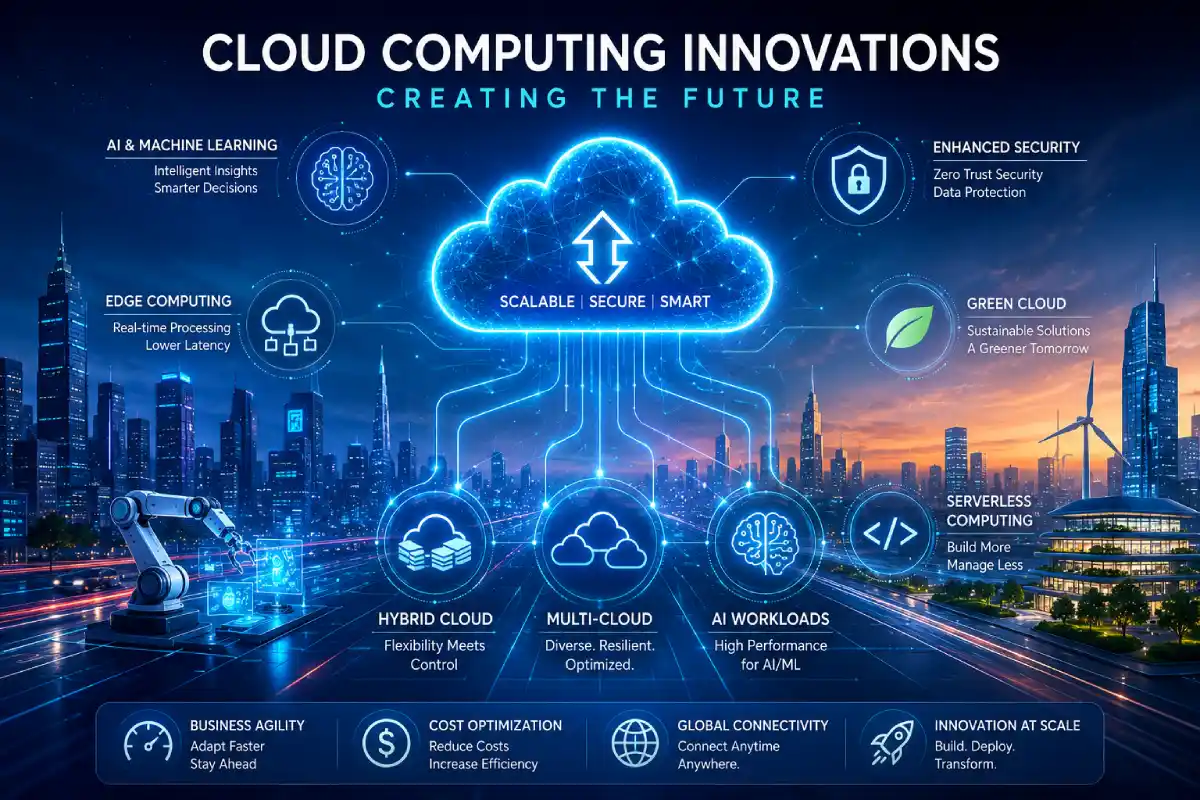
Cloud Computing Innovations – Cloud computing has come a long way and has become the foundational technology in the ongoing digital transformation era. Several businesses around the world are utilising the same technology in improving their strategies to develop AI models, working with vast data, remote workforce and working their core applications.
Hence as the world leaps forward, it’s only obvious that in 2026 the world will be able to clearly see how fast the cloud innovations are evolving the world and how people are embracing and utilizing hybrid cloud, serverless, multi-cloud, and AI based cloud platforms for greater agility, efficiency, and security.
So, whether you are a startup founder, an IT professional, engineer or a business owner, make sure you are up-to-date with every aspect of these developments, if you wish to excel in this era of digital revolution.
Table of Contents
Why Cloud Computing Continues to Evolve

Cloud-enabling technologies the need for fast data analysis capabilities, ai integration and flexible infrastructure forced cloud vendors to develop solutions that offer capabilities in addition to merely serving data on a server.
Key drivers include:
- Growing AI and machine learning adoption
- Demand for remote and distributed work environments
- Increased cybersecurity requirements
- Need for scalable computing resources
- Rising volumes of business data
- Expansion of edge computing and IoT
Cloud Computing Innovation Timeline
| Generation | Focus Area | Key Innovation |
| Cloud 1.0 | Infrastructure | Virtual Machines |
| Cloud 2.0 | Scalability | Containers & Kubernetes |
| Cloud 3.0 | Automation | Serverless Computing |
| Cloud 4.0 | Intelligence | AI-Powered Cloud Services |
| Cloud 5.0 | Optimization | Autonomous Cloud Operations |
Many organizations today find themselves in the age of Cloud 5.0 where infrastructure is being automated, managed by artificial intelligence, and predictively handled with minimal human intervention.
Latest Cloud Computing Trends

The most prevalent cloud computing trends for 2026 will involve agility, intelligenc,e and automation. Instead of looking for only an infrastructure, organizations want something that automatically optimises performance.
1. AI-Powered Cloud Platforms
Providers are offering AI as part of the cloud platform itself.
Benefits include:
- Automated resource allocation
- Predictive maintenance
- Intelligent security monitoring
- Cost optimization recommendations
- Automated workload balancing
Example Applications
| AI Cloud Feature | Business Benefit |
| Predictive Analytics | Better decision-making |
| Intelligent Scaling | Reduced downtime |
| AI Security Monitoring | Faster threat detection |
| Cost Optimization Engines | Lower cloud spending |
2. Edge Cloud Computing
Edge computing provides a closer processing location for users and devices.
Advantages include:
- Lower latency
- Faster application response
- Reduced bandwidth costs
- Improved IoT performance
Industries benefiting include:
- Healthcare
- Manufacturing
- Smart cities
- Retail
- Autonomous vehicles
3. Sustainable Green Cloud Computing
The main thing to come of late among cloud service providers is the consideration of their contribution towards sustainability.
Modern innovations include:
- Carbon-aware computing
- Energy efficient Data centers
- Infrastructure running on renewable energy
- A workload scheduler that can also enable saving power
Organizations are increasingly choosing cloud providers on account of environmental impact indicators.
Hybrid Cloud Innovations
With the development of private and public cloud, a growing number of enterprises now take the hybrid cloud as the optimal form that gives rise to a flexibility and autonomy.
Private cloud, however, has such limits. But a growing number of enterprises take hybrid cloud as the optimal form that balances security and scalability of cloud.
What Is Hybrid Cloud?
A hybrid cloud combines:
- Private cloud resources
- Public cloud services
- On-premise infrastructure
All environments work together through secure integrations.
Hybrid Cloud Architecture
| Component | Purpose |
| Public Cloud | Scalability |
| Private Cloud | Security |
| On-Premise Systems | Legacy Applications |
| Cloud Management Layer | Unified Control |
Latest Hybrid Cloud Innovations
Intelligent Workload Placement
AI systems automatically determine where workloads should run based on:
- Performance requirements
- Cost considerations
- Compliance regulations
- Security policies
Unified Cloud Management
Organizations may now control several environments from one dashboard.
Benefits include:
- Simplified administration
- Reduced operational complexity
- Better visibility
- Improved governance
Advanced Security Integration
Modern hybrid clouds feature:
- Zero-trust architecture
- Identity-based access control
- Automated compliance monitoring
- Real-time threat detection
Hybrid Cloud vs Traditional Infrastructure
| Feature | Traditional IT | Hybrid Cloud |
| Scalability | Limited | High |
| Cost Efficiency | Medium | High |
| Flexibility | Low | High |
| Security Control | High | High |
| Innovation Speed | Slow | Fast |
Serverless Computing Explained
The next innovation that’s really changing the cloud technology game is what’s called “serverless” computing, but don’t be fooled by the name – it does rely on servers at some level. However, developers no longer manage them directly.
The cloud provider handles:
- Infrastructure
- Scaling
- Updates
- Maintenance
- Resource allocation
Developers work only on writing the code.
How Serverless Computing Works
Your applications will run from a function that is based on an event.
Examples include:
- File uploads
- Database updates
- User registrations
- API requests
The cloud platform automatically launches computing resources when required.
Benefits of Serverless Computing
Lower Costs
Organizations pay only for actual execution time.
Automatic Scaling
Applications instantly scale based on demand.
Faster Development
Developers spend less time managing infrastructure.
Improved Agility
New features can be deployed rapidly.
Serverless vs Traditional Cloud
| Feature | Traditional Cloud | Serverless |
| Server Management | Required | Not Required |
| Scaling | Manual | Automatic |
| Cost Model | Fixed Resources | Pay-Per-Use |
| Deployment Speed | Moderate | Fast |
| Maintenance | High | Minimal |
Common Serverless Use Cases
| Application | Suitability |
| APIs | Excellent |
| Chatbots | Excellent |
| AI Inference | High |
| Data Processing | High |
| Image Analysis | High |
The standard architecture for cloud native apps in the next decade Serverless will emerge as the standard cloud-native architecture over the next 10 years.
Multi-Cloud Strategies 2026
Organizations no longer place their bets on just one cloud provider.
Instead, workload is shared out across many systems.
This practice is called using a multi-cloud approach.
Why Businesses Adopt Multi-Cloud
Primary reasons include:
- Avoiding vendor lock-in
- Increasing resilience
- Improving performance
- Meeting compliance requirements
- Accessing specialized services
Multi-Cloud Benefits
Better Reliability
If a provider fails, the workloads keep on running.
Cost Optimization
Organizations can choose the most affordable services across providers.
Enhanced Security
Critical workflows can be intelligently allocated
Cloud Challenges
| Challenge | Solution |
| Complexity | Centralized Management Tools |
| Security Risks | Unified Security Policies |
| Cost Tracking | Cloud Cost Platforms |
| Skills Gap | Cloud Training Programs |
Multi-Cloud vs Hybrid Cloud
| Factor | Hybrid Cloud | Multi-Cloud |
| Uses Public Cloud | Yes | Yes |
| Uses Private Cloud | Yes | Optional |
| Multiple Providers | Not Always | Yes |
| Flexibility | High | Very High |
| Complexity | Moderate | High |
Multi-Cloud Best Practices for 2026
- Standardize security controls.
- Use centralized monitoring tools.
- Automate governance policies.
- Implement cloud cost management.
- Maintain workload portability.
However those who manage their networks in this way can achieve improved availability and a better risk level.
Cloud Computing for AI Workloads
AI Is Turning Into the Biggest Consumer of Cloud. Training and deploying AI models is extremely computationally intensive and that computing power is ideally suited for cloud resources that can be allocated on-demand.
Why AI Needs Cloud Computing
AI systems require:
- High-performance GPUs
- Massive storage capacity
- Scalable infrastructure
- Real-time data processing
- Global accessibility
Cloud computing delivers all these capabilities efficiently.
AI Cloud Infrastructure Components
| Component | Purpose |
| GPUs | AI Model Training |
| TPUs | Deep Learning Acceleration |
| Data Lakes | Large-Scale Storage |
| Kubernetes | AI Deployment |
| Serverless AI Services | Inference Processing |
Emerging AI Cloud Innovations
AI Accelerators
Boost Machine Learning performance with processors dedicated to machine learning.
AI-as-a-Service
Companies can take advantage of sophisticated AI models without having to build their own.
Automated Machine Learning (AutoML)
Cloud platforms automatically train and optimize models.
Generative AI Integration
Cloud providers now offer built-in generative AI services for:
- Content creation
- Customer support
- Code generation
- Data analysis
Cloud Platforms Supporting AI
| Capability | Importance |
| GPU Availability | Critical |
| AutoML Features | High |
| Data Integration | High |
| Model Deployment Tools | Critical |
| Security Controls | Critical |
Future of Cloud Computing Innovations
The next generation of cloud computing will be shaped by:
- Autonomous cloud operations
- Quantum cloud services
- AI-driven infrastructure management
- Sustainable cloud computing
- Edge-AI integration
- Advanced cybersecurity automation
The early adoption of these trends for companies will unlock major competitive advantages such as higher efficiencies, reduced costs and a faster innovation process.
Conclusion
Cloud Computing Trends that are shaping what’s next for business in the cloud This technology is transforming how businesses build, run and scale digital services-including innovative hybrid cloud environments and serverless infrastructures, and even advanced multi-cloud strategies and cloud platforms built around AI.
As technology continues to evolve, cloud computing is at the core of every digital transformation initiative. Businesses that embrace modern cloud strategies now will be positioned to innovate and compete with the best in the technology world of 2026 and beyond.