
Last Updated: September 23, 2026
Edge Computing Architecture in IoT – Through Internet of Things, machine devices and systems have had communication revolution. From intelligent houses, connectable vehicles to smart factories and patient health monitoring systems, the IoT technology supports minute by minute decisions, which implies, data from devices becomes massive as they are connected. Sending each and every byte of the device to a remote cloud system is impractical for numerous real-life scenarios and that’s where IoT architecture of edge computing is relevant.
This article belongs to Internet of Things
Edge computing moves computation closer to the devices that collect the data. Instead of only depending on cloud servers for analysis of IoT devices, information could be processed at the edge, such as on sensors, local controllers, and IoT gateways. This minimizes the latency, economizes the network bandwidth, and enables reliability, extensibility and real-time systems. Essentially, edge computing enables an IoT system to think faster.
In this article, we introduce the architecture of edge computing in IoT by using an intuitive and practical perspective. The architecture comprises the main layers, role of edge gateway, the distinction between fog and edge computing and the design principles of an effective IoT edge network.
Table of Contents
What is Edge Computing in IoT?
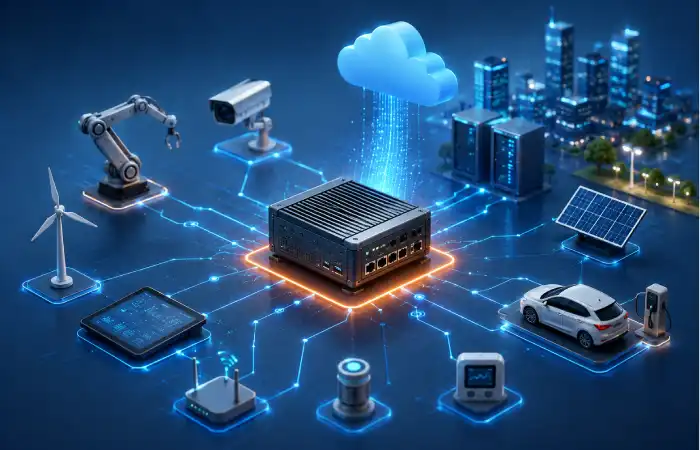
Edge computing in IoT means a distributed model for computation whereby processing is done locally on device or on proximate local servers rather than at remote cloud. In an IoT application the enormous number of device that capture from sensor, machinery, camera, wearables, or vehicles and relay information to the cloud first, will cause severe overload to the network and increase response time.
The solution of edge computing is to put some part of the processing into local devices or close local servers. For instance, an abnormal vibration is detected from machinery locally within the factory; an alert will be generated at edge immediately before waiting for cloud analysis; smart traffic camera can detect a traffic jam and adjust traffic signal timing in real time.
The main advantages of edge computing are not only speed, but also feasibility of enabling IoT application run continuously without internet connectivity, particularly in applications such as industrial, health, transportation, agriculture, and smart city.
For a broader introduction to the technology, see this guide to edge computing in IoT
IoT Edge Architecture Explained
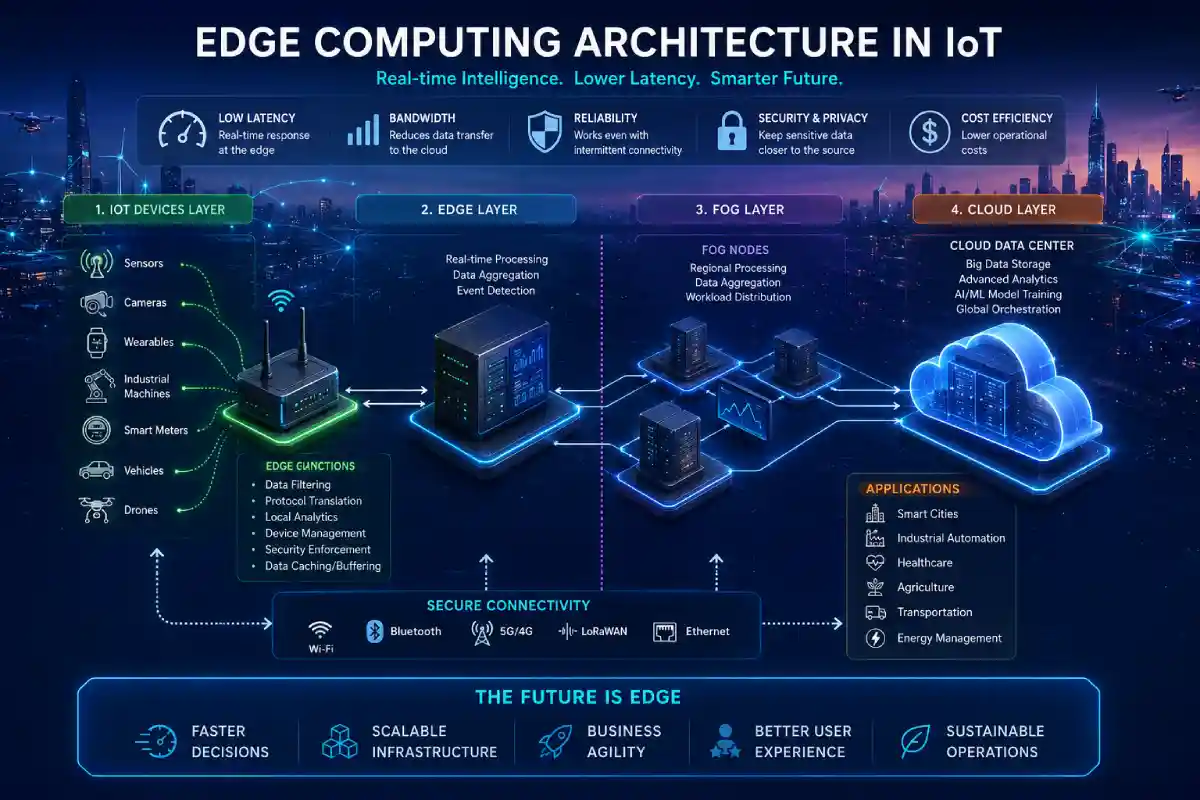
An IoT edge architecture is a framework that enables the flow, storage, processing, and communication of data between devices, gateways, edge nodes, and the cloud. These frameworks are commonly designed as layered models whereby each layer is assigned its role.
At device level- sensors and actuators perceive data from the physical world. Edge level- local processing of data occurs to filter, analyze and act on the data locally to respond swiftly to changes. Cloud level- data is stored on a large scale and deep analysis is carried out along with long term decision-making.
The main idea of IoT edge architecture
| Layer | Main Role | Example |
| Device Layer | Sensing and actuation | Temperature sensors, cameras, smart meters |
| Edge Layer | Local processing and filtering | Edge gateways, local AI modules |
| Fog Layer | Intermediate distributed processing | Regional nodes, micro data centers |
| Cloud Layer | Storage, analytics, orchestration | Public cloud platforms, dashboards |
This design allows IoT systems to be able to react in real-time while also leveraging the power and scale of the cloud.
Edge Computing Layers in IoT
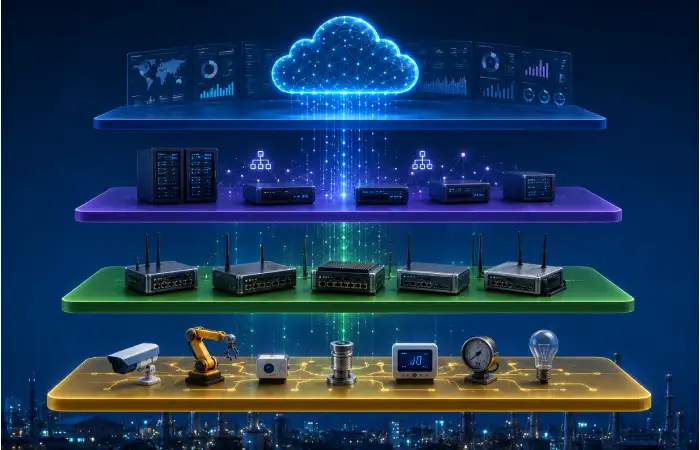
There are many layered descriptions of IoT edge computing because there is different levels of workload and intelligence on each layer. A layered structure is easy to manage, expand and secure.
1. Device Layer
Data originates here. Sensors, cameras, RFID tags, wearables, controllers etc. Measure real world phenomena. Generally these devices have limited processing capability and storage capacity so they are designed primarily for data acquisition and basic operations.
2. Edge Processing Layer
The functions to do at this level. It might be executed at gateway, router, industrial PC, embedded device or at local server. This layer might do data cleaning, deduplication, anomaly detection, data compression or making simple decisions.
As an example, at smart building, motion sensor send its raw information to the edge gateway. The gateway can make simple decisions such as normal or suspicious motion and pass information relevant to cloud only.
3. Fog Layer
Fog computing-lying somewhere between the edge and the cloud. It is a more powerful entity than the edge, but is closer to the devices than an off-site data center. Node fog can come into play when coordinating and aggregating across multiple edge devices, or when regional analytics are required.
4. Cloud Layer
The cloud is used for intensive jobs like historical analysis, model training, world monitoring and enterprise reporting. AI and machine learning can also extend intelligence across the edge, as explained in this guide to edge computing AI and ML That’s where the organization store vast amount of data, and can execute huge AI or machine learning. While the cloud is powerful, it is not always the best place for instant decisions.
Comparison of IoT edge layers
| Layer | Proximity to Devices | Processing Speed | Typical Use | Limitation |
| Device Layer | Very close | Low | Data collection | Limited resources |
| Edge Layer | Close | High | Real-time response | Smaller storage and compute |
| Fog Layer | Medium | Medium to high | Regional coordination | More complex management |
| Cloud Layer | Far | Very high | Deep analytics and storage | Higher latency |
This layered model is one of the reasons IoT systems can now support both real-time intelligence and large-scale analytics.
Fog vs Edge Computing in IoT
Fog computing is strongly linked to edge computing and most people confuse these two terms. They are not exactly the same. Edge computing focuses on computations at or closer to the device while fog computing processes tasks at locations a little further away-between edge and cloud.
Edge computing is ideal for quick local decision-making and the fog computing concept fits better where we need several edge nodes communicating with each other, or when the work requires more computation power than what one gateway can handle.
Fog vs Edge Computing comparison table
| Feature | Edge Computing | Fog Computing |
| Location | At or near devices | Between edge and cloud |
| Latency | Very low | Low |
| Processing Scope | Local and immediate | Regional and distributed |
| Best For | Real-time reactions | Coordination and aggregation |
| Infrastructure | Gateways, local controllers, embedded devices | Regional servers, fog nodes, micro data centers |
| Example | Machine fault detection on site | Smart city traffic management across several intersections |
Many modern IoT systems actually use a combination of the above. In this system, the edge is used for critical and time-sensitive tasks, fog for general orchestration, and the cloud for intelligent learning in the long term.
Another good analogy is that edge computing is the first responder, fog computing is the local command center and the cloud is the headquarters.
Edge Gateway Architecture
An edge gateway is one of the most important parts of an IoT edge architecture. The gateways, controllers, and other components involved are part of the wider ecosystem of edge computing IoT devices and hardware. It acts as a bridge between low-power devices and higher-level systems such as fog nodes or the cloud. Since many IoT sensors use different communication protocols, the gateway also helps translate between them.
For example, a factory may have sensors using Zigbee, BLE, Modbus, or MQTT. The edge gateway collects this data, normalizes it, filters out noise, and sends only useful information to the next layer.
Core functions of an edge gateway
| Function | Purpose |
| Protocol translation | Connects devices using different communication standards |
| Data filtering | Removes unnecessary or duplicate data |
| Local analytics | Detects patterns, failures, or anomalies |
| Security enforcement | Authenticates devices and controls access |
| Buffering | Stores data temporarily when cloud access is unavailable |
| Device management | Monitors and updates connected devices |
Edge gateway architecture flow
| Step | Action |
| 1 | Sensors collect raw data |
| 2 | Gateway receives and aggregates the data |
| 3 | Gateway filters, compresses, or analyzes it |
| 4 | Important results are sent to cloud or fog |
| 5 | Immediate actions are triggered locally if needed |
Edge gateways are especially valuable in environments where speed and reliability matter. In a hospital, they can help process patient data quickly. A factory can reduce machine downtime. A smart city can manage local traffic, lighting, and surveillance systems more efficiently.
Designing an IoT Edge Network
Creating an IoT edge network is more than just adding a few gateways near your sensors. There is strategic thinking required with regards to data flow, latency, security, device types, and scalability. A solid edge network needs to be efficient and secure, and scale with ease.
1. Define the real-time needs
It is important to note that not all IoT applications must occur at the edge. Certain devices and applications can tolerate cloud latency whereas others cannot. An intelligent irrigation system might not require instantaneous updates whereas an autonomous robot or vehicle does. As an initial step we need to define the requirements that need to be handled at the local level.
2. Place intelligence where it matters
Any tasks that needs a real-time decision needs to be kept near the devices. These would include; anomaly detection, motion detection, triggering machine shutdown, safety warnings etc. Tasks that do not require real-time input such as reporting, data archiving and trend analysis could be transferred to the cloud.
3. Use the right hardware
An edge network may include embedded controllers, industrial PCs, smart gateways, and micro servers. The right choice depends on workload, power availability, and environmental conditions. A dusty factory floor may require rugged hardware, while a smart retail environment may only need compact gateways.
4. Build for interoperability
Rarely IoT devices are coming from one vendor and protocol. It is essential to support multiple protocols on the edge architecture for example: MQTT, HTTP, CoAP, Zigbee, BLE, LoRaWAN and industrial protocols. Interoperability also avoid vendor lock-in and easy to add more device in the future.
5. Prioritize security
Security becomes more crucial at the edge where the data is processed at many disparate locations. Each device, gateway, and edge node must be authenticated and observed. The need of encryption, secure boot, access control, patching and logging are essential at the edge. An unsecured edge would pose a risk to the entire IoT system.
IoT edge network design checklist
| Design Area | What to Consider |
| Latency | Which actions require instant response? |
| Connectivity | Is network access stable or intermittent? |
| Security | How are devices authenticated and protected? |
| Compatibility | Do devices support common protocols? |
| Scalability | Can new devices be added easily? |
| Maintenance | How will updates and monitoring be handled? |
The illusion of non-existence is perhaps what most strongly signifies a well functioning IoT edge network: the responsiveness of the devices, the validity of the data output, and that the relevant and only the relevant data streams reach the cloud.
Benefits of Edge Computing Architecture in IoT
Edge computing offers multiple benefits for IoT systems.
It decreases latency since data does not always need to travel a long way to the cloud before a decision can be made, important for time-sensitive environments.
It decreases the required bandwidth because the volume of data does not need to be transferred through a network. Raw data can be filtered or summarized at the edge.
It increases reliability because even when an internet connection is poor or broken, the edge device is still capable of working.
Enhances security and privacy in certain scenarios because sensitive data can be processed on the local device rather than transferred through networks.
Enables more intelligent automation, decisions can be made on the local device instantly and the process can be more responsive.
Key benefits summary
| Benefit | Why It Matters |
| Low latency | Faster response times |
| Bandwidth savings | Less network congestion |
| Reliability | Works even with poor connectivity |
| Privacy | Keeps sensitive data local |
| Smarter automation | Enables immediate local actions |
Challenges in IoT Edge Architecture
Despite the strengths of edge computing, it is also faced with many challenges. The greatest one is the complexity issue. A distributed system having multiple devices and gateways would not be easy to be managed compared to a pure cloud infrastructure.
Maintenance is another issue. The devices in edge computing environment are normally dispersed over a variety of geographical location and their upgrade will be a difficult task. Security issues are more complex to handle too, as every node in the edge has to be secured.
Limit of resource is an important challenge. Memory, storage, and power of an edge device is considerably smaller than that of cloud server, so that the workload design has to be well done.
Integration is also not always smooth, as different hardware, software, and communication standards are required to collaborate in a unified ecosystem.
Real-World Use Cases
This architecture is enabling a multitude of changes across industries.
In manufacturing it enables the predictive maintenance, monitoring of machinery and automation of safety systems. In healthcare, it helps in quick processing of patient information and can be used for remote monitoring. The smart city initiatives depend on this type of technology for their traffic lights, surveillance cameras, waste management and environmental sensing applications. Agriculture can employ this to monitor soil and water conditions and weather. Transportation depends on this for effective fleet tracking and optimization of routing, and safety features.
These represent just a few examples. However it can be seen that edge computing is much more than a fad. It is rapidly becoming essential for contemporary IoT applications.
Final Thoughts
IoT edge computing architecture is one of the critical transformations taking place in the current connected world. The use of edge computing devices helps in speedier processing of data and diminishes the burden on cloud networks to provide an efficient and practical IoT environment. Organizations use a combination of devices, edge nodes, fog layers, and cloud infrastructure to build an IoT architecture that is responsive, scalable, and intelligent.
The best IoT solutions do not necessarily decide against cloud or edge; they make use of the strengths of both-the cloud to analyze massive amounts of data in depth and in detail and the edge and fog to address issues concerning urgency, agility, coordination, and ubiquity. This provides an efficient and futuristic connected intelligence system.
While architecting a new IoT solution, it has become an imperative for organizations not to disregard the edge architecture as part of the solution.