
Last Updated: September 23, 2026
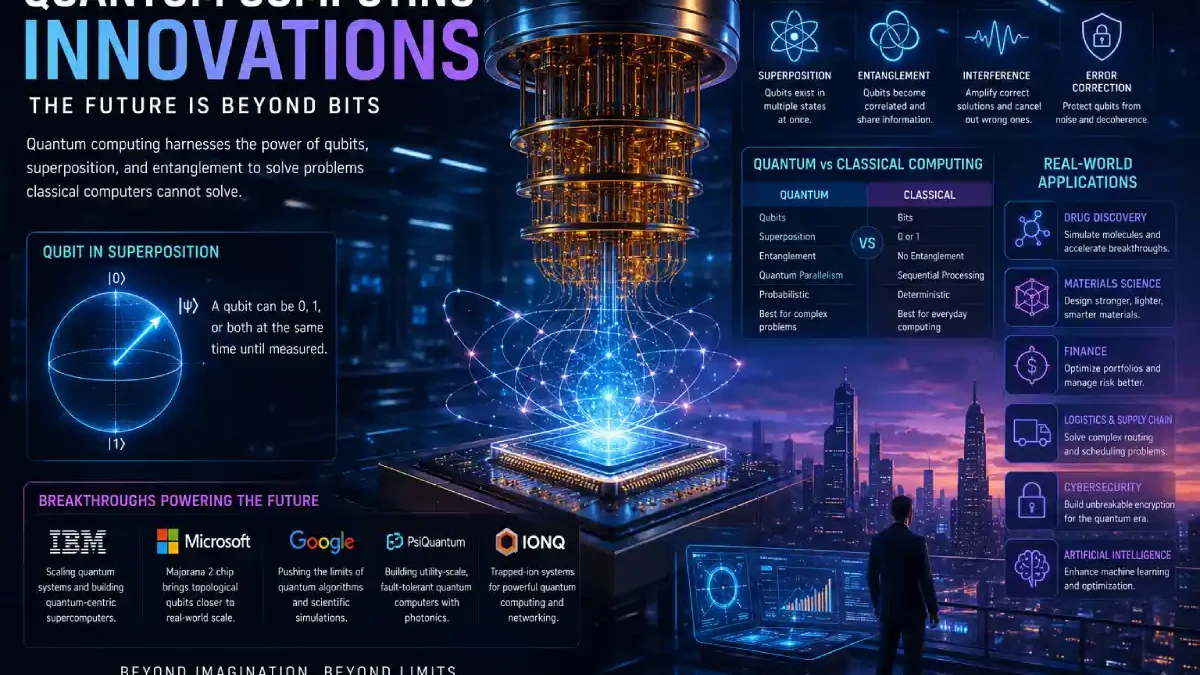
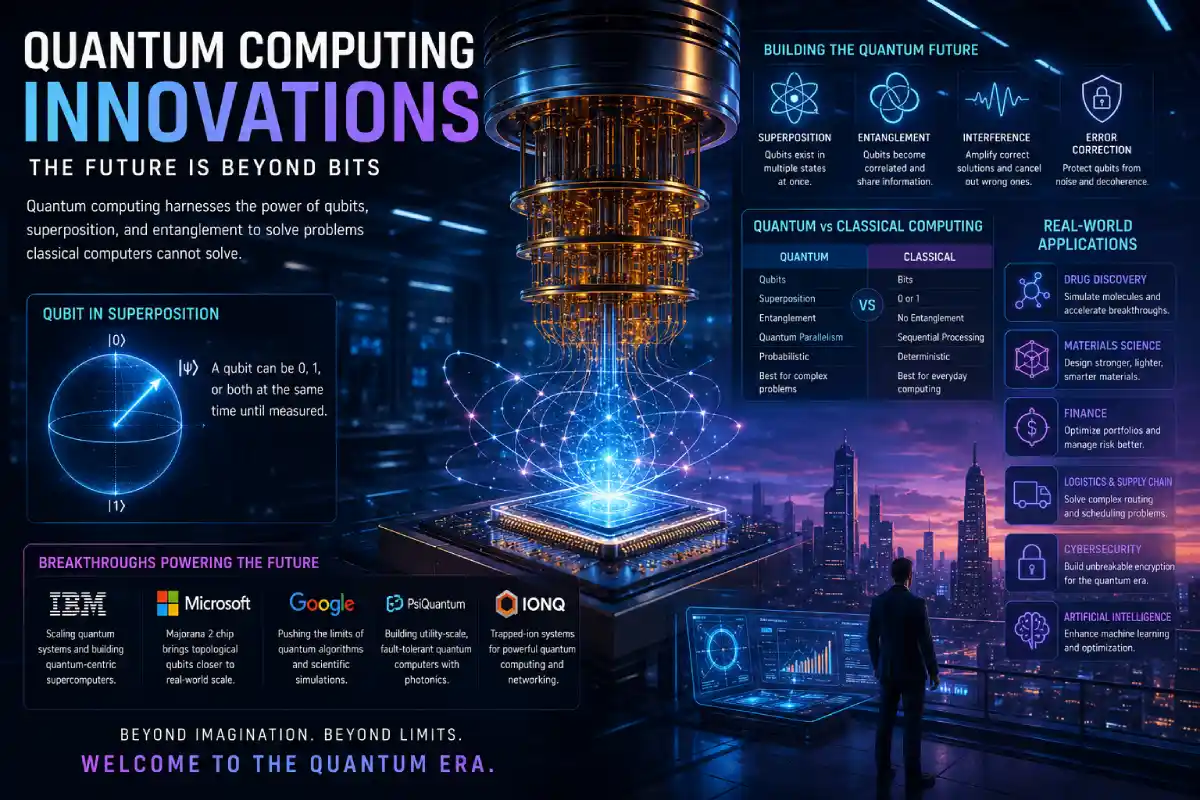
Quantum Computing Innovations – Quantum computing has finally moved past being a laboratory curiosity that everyone speculates about in terms of “when in the future”. The quantum industry in 2026 has grown with large investments, error correction improvements, new chip designs, and a strong push for real-world use in chemistry, materials science, optimization, and security. Big tech is leading efforts with IBM releasing a 5-year quantum investment of over 10 Billion dollars; Microsoft releasing Majorana 2, said to be 1,000x more reliable than the last generation, and PsiQuantum also growing their real-world infrastructure for utility scale fault tolerant systems.
The most interesting shift is not that quantum computing has replaced classical computing. It has not. The real story is that the industry is slowly moving from “promising physics” toward “usable engineering.” That means better qubits, better software, better hybrid workflows, and clearer use cases where quantum methods can eventually add value that classical machines cannot easily match.
This article belongs to Future Computing
Quantum computing is also part of the broader evolution taking place across computing innovations, as new architectures and specialized systems continue to expand what modern computing can do.
Table of Contents
What is Quantum Computing
Quantum computing is another approach to computing; instead of a bit that is only capable of being 0 or 1, a quantum computer uses a qubit, that due to superposition and entanglement, can exist in a state of 0 and 1 simultaneously. It is “a computational model” Microsoft states that “can address certain highly combinatorial problems with stunning performance,” and IBM states that “Quantum computers are designed to tackle the most demanding of computational problems and can solve a large class of problem beyond the reach of even the most powerful classical systems.”
A simple analogy would be, classic computers are excellent at being certain, having logical operations to perform sequentially, and performing those operations dependably, quantum computers have been designed to be excellent at problem areas where there are vast amounts of possibilities, where simulating them, probability, and how they behave on a molecular level is far more important than calculating arithmatic. Chemistry, materials science, crypto graphy, optimization are some of the scientific problem areas where it all occurs.
It is also useful to remain aware of the realistic expectations for the machines; it is not going to be able to take every computational problem and run them faster than a classical machine; Microsoft say it is not going to be ‘a faster, universal computer’, and IBM acknowledge “the greatest benefits from quantum computing are likely to be realized in certain computational science and engineering areas, rather than in common computing applications” (which is good news if your concerned about streaming video and using a spreadsheet).
Quantum Computing Breakthroughs 2026
The headline theme in 2026 is reliability. IBM unveiled a quantum-centric supercomputing reference architecture in March 2026, aiming to coordinate quantum and classical workflows in a practical system design. In June 2026, IBM also announced plans to invest more than $10 billion in quantum computing over the next five years, covering R&D, manufacturing scaling, partnerships, and acquisitions.
IBM also reported a science milestone in March 2026: researchers used quantum computing to help create and study a previously unseen molecule with a half-Möbius electronic topology. That matters because quantum machines are most compelling when they help scientists understand complex molecular behavior, not just run abstract demos.
Microsoft’s biggest 2026 news was Majorana 2, announced in June. Microsoft said the new topological chip uses a new materials stack that makes qubits 1,000 times more reliable than before, and the company now expects to reach a scalable quantum computer by 2029. Microsoft also tied the work to its broader Discovery platform, where AI helps manage workflows, optimize fabrication, and speed up scientific discovery.
Psi Quantum’s 2026 activity shows another important trend: quantum computing is becoming an infrastructure game, not just a hardware race. In May 2026 the company opened a Test & Validation Lab at Griffith University, announced a new Australian site at Moreton Bay Central, and described its mission as building the world’s first useful quantum computer through a photonic, fault-tolerant approach.
Breakthroughs at a glance
| 2026 breakthrough | Why it matters | Source |
| IBM’s $10B quantum investment | Signals long-term confidence, manufacturing scale, and ecosystem growth | |
| IBM quantum-centric supercomputing architecture | Brings quantum and classical systems into one workflow model | |
| IBM molecule discovery with quantum hardware | Shows a direct scientific use case in molecular chemistry | |
| Microsoft Majorana 2 | Pushes topological qubits toward better reliability | |
| PsiQuantum’s 2026 site expansion | Suggests a serious push toward utility-scale, fault-tolerant systems |
All these events tell us something in particular: it is time when the next stage in quantum computing moves from hype and bluster to engineering stability, software development, and actual scientific results-which is the sort of thing that always counts, after all, when a technology steps out of the lab and toward the market.
Best Quantum Computing Companies
There is no single “winner” in quantum computing yet. Different companies are betting on different hardware paths and software stacks. The best companies to watch are the ones that have a believable technical roadmap, active research output, and a clear strategy for useful applications.
Company comparison table
| Company | Main approach | What stands out |
| IBM Quantum | Full-stack quantum computing with 100+ qubit systems and Qiskit software | IBM says it has the world’s largest fleet of 100+ qubit quantum computers and is backing the field with a major 2026 investment. |
| Microsoft Quantum | Topological qubits and hybrid quantum-classical workflows | Microsoft’s Majorana 2 announcement focused on reliability, and its platform is built around chemistry, materials science, and AI-assisted discovery. |
| Google Quantum AI | Quantum algorithms and physical simulation research | Google says it focuses on simulation of physical systems, especially interacting electrons for chemistry and materials science, and its Quantum Echoes result showed verifiable quantum advantage on hardware. |
| Quantinuum | Trapped-ion hardware plus advanced software | Quantinuum positions itself as the world’s largest integrated quantum company and says its Helios platform delivers top-tier commercial accuracy. |
| IonQ | Trapped-ion quantum systems, networking, sensing, and security | IonQ presents itself as a leading quantum platform company and emphasizes real-world use across computing, networking, sensing, and security. |
| D-Wave | Annealing and gate-model quantum systems | D-Wave calls itself the world’s first commercial supplier of quantum computers and the only dual-platform quantum company, with a strong focus on optimization. |
| PsiQuantum | Photonic, fault-tolerant quantum computers | PsiQuantum is building utility-scale, fault-tolerant systems and expanded its 2026 infrastructure in Australia and the U.S. |
| Rigetti | Superconducting QPUs | Rigetti’s Novera QPU is a ready to ship 9-qubit superconducting system. This positions them well as a hardware company for researchers and developers. |
The reading, if you’d like it, is this: IBM and Microsoft playing broad platform plays, Google playing research and algorithm milestones, Quantinuum and IonQ strong in trapped-ion, D-Wave a big player in optimization, PsiQuantum putting money into photonics and utility scale fault tolerance, and Rigetti still an established player in superconducting.
Quantum vs Classical Computing
Quantum and classical computers are not enemies. They are tools for different jobs. The almost universal choice remains classical machines due to them being cheaper and reliable and so completely predictable. Quantum machines are still far too noisy and prone to error and so error correction, fault tolerance, and hybrid working are a huge topic. Microsoft states, in so many words, that classical computers were developed to be extremely reliable and predictable, while quantum computers are inherently noisy and need specific correction methods.
Comparison table
| Aspect | Classical Computing | Quantum Computing |
| Basic unit | Bit: 0 or 1 | Qubit: can exist in multiple states |
| Main strength | Reliable everyday computation | Certain complex scientific and combinatorial problems |
| Behavior | Deterministic and stable | Noisy and error-prone without correction |
| Best for | Web apps, spreadsheets, databases, general software | Chemistry, materials, optimization, simulation, cryptography research |
| Current maturity | Mature and dominant | Emerging and rapidly evolving |
The practical lesson is simple: classical computing will continue to run most of the digital world, while quantum computing will likely become a specialist engine for scientific discovery and hard optimization problems. That is why many companies now talk about hybrid systems instead of a single “quantum-only” future.
Hybrid systems also highlight the continued importance of scalable infrastructure, including cloud computing, which can provide access to specialized computing resources without requiring every organization to operate its own hardware.
Real-World Quantum Computing Applications
The strongest near-term opportunities for quantum computing are in fields where nature itself is quantum. That is why chemistry, materials science, and molecular simulation appear again and again in official roadmaps from IBM, Microsoft, and Google. Google says simulation of physical systems is among the most anticipated applications of quantum computing, especially for interacting electrons in chemistry and materials science. Microsoft similarly highlights batteries, self-healing materials, and coolants without forever chemicals.
Application table
| Application area | Why quantum may help | Example direction |
| Chemistry and materials science | Quantum systems can model molecular and electronic behavior more naturally | Better batteries, catalysts, and materials discovery |
| Optimization and logistics | Quantum and annealing methods are suited to large combinatorial search spaces | Routing, scheduling, workforce planning, supply chains |
| Finance | Portfolio and risk problems involve massive scenario spaces | Portfolio optimization and market analysis |
| Healthcare and life sciences | Molecular simulation can speed up discovery | Drug discovery and protein-structure analysis |
| Cybersecurity | Quantum progress increases pressure to upgrade security systems | Post-quantum cryptography migration and long-term secure communications |
| AI and Hybrid workflows for discovery | Quantum, AI and HPC can be synergistic. | Discovery becomes faster and the models more precise |
D-Wave’s “favorite’ words include optimization, logistics, scheduling, materials simulation and supply-chain management while IonQ likes words such as logistics, drug discovery and national-defense-level problems. IBM’s learning materials also point to chemistry, materials science, finance, healthcare, and manufacturing as important business impact areas.
Security is another real-world angle that often gets overlooked. Google has already framed the “quantum era” as a reason to accelerate post-quantum cryptography migration, which is a reminder that quantum computing affects the world even before it becomes broadly fault tolerant. In other words, the impact is not only what quantum computers can do, but also how they change the way we defend digital systems.
Quantum infrastructure also has an energy dimension, particularly as researchers and data centers consider the power requirements of increasingly complex hybrid computing environments. This connects quantum development with the broader goals explored through green computing, where efficiency and responsible use of computing resources are becoming increasingly important.
Final Thoughts
The field of quantum computing is still developing but it is becoming less theoretical. This activity in 2026 reveals a stronger pattern, namely more reliable qubits and hardware, hybrid designs, and a more concrete catalog of applications, IBM focuses on scale, Microsoft on topological reliability, Google can demonstrate algorithmic success, and Quantinuum, IonQ, D-Wave, PsiQuantum and Rigetti are all marching along different routes to useful quantum machines.