
Last Updated: June 25, 2026
Edge Computing Basics for IoT – IoT has radically changed how devices communicate with each other. Smart home appliances, sensors in a factory; they all rely on high speed data transmission and rapid response. However, as the number of IoT devices increases exponentially, sending every little data point all the way to a distant cloud is no longer efficient.
This is where edge computing comes into the picture.
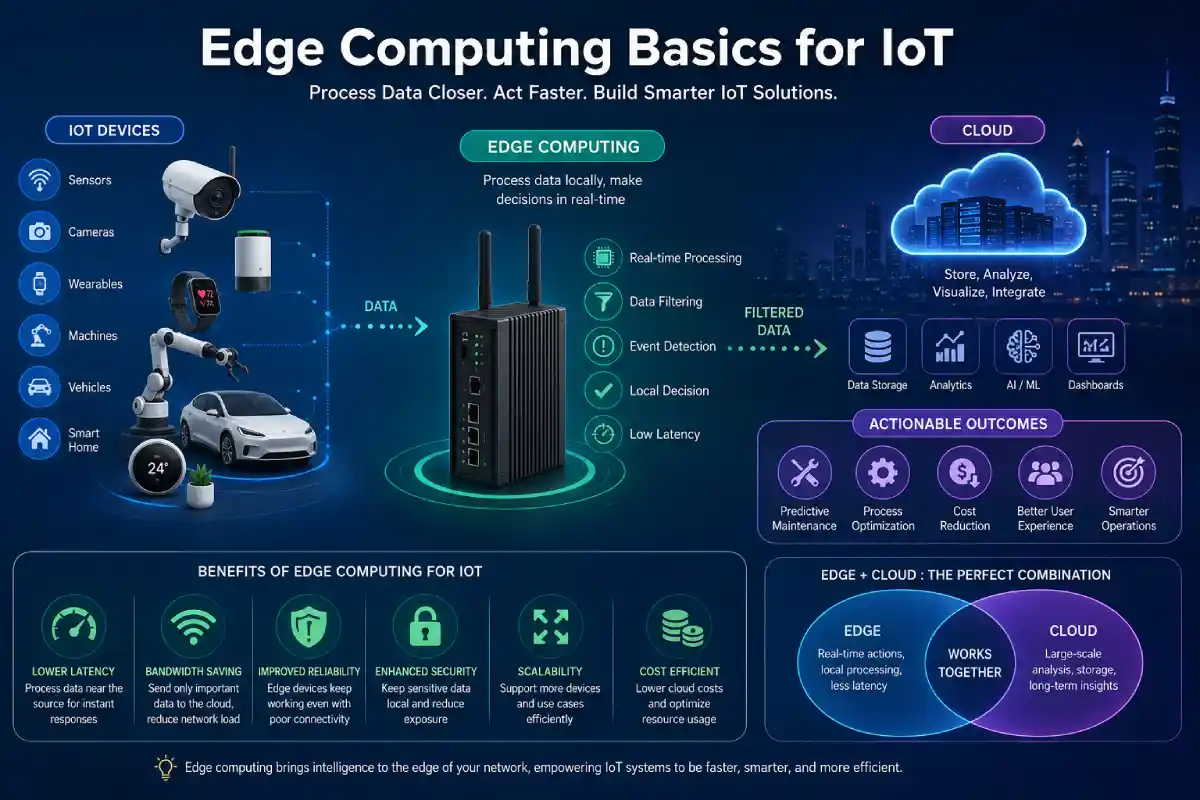
Edge computing basically pushes computing resources closer to the data’s point of origin. Instead of sending everything to a far off cloud server, a portion of the data is processed by an edge device, a gateway or a local node. This has a massive implication on speed, latency and costs for IoT systems.
In simplest terms, edge computing empowers an IoT device to think faster.
Table of Contents
What is Edge Computing in IoT
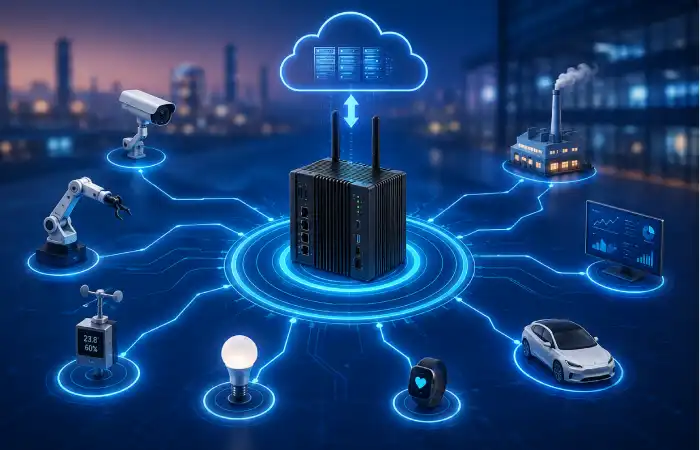
IoT edge computing refers to processing the data locally, at or near the device which created the data rather than solely at a centralized cloud server. In a smart factory environment there could be hundreds of sensors at a given factory, generating vast amounts of data constantly on temperature, vibrations, pressures and the speed at which a machine is rotating.
If this information were all sent to the cloud immediately then the system would be too slow to be useful, an edge system would instantly analyze this information at an on site computer and be able to know if there is a machine issue.
This local processing is useful wherever immediate action matters. It can be found in:
- Smart homes
- Healthcare devices
- Industrial automation
- Connected cars
- Retail systems
- Agriculture sensors
- Smart cities
Edge computing does not replace the cloud. It is cloud connected. For critical tasks it is the edge, for mass data storage, deep analysis and long term management it is the cloud.
Simple Definition
| Term | Meaning |
| IoT | A network of interconnected devices that gather and share data |
| Edge Computing | Processing data near the device and not just in the cloud |
| Edge Device | A nearby piece of equipment which can manipulate, filter or analyze data. |
| Cloud Computing | Cloud services to store data and processing, analytics on stored data. |
How Edge Computing Works in IoT
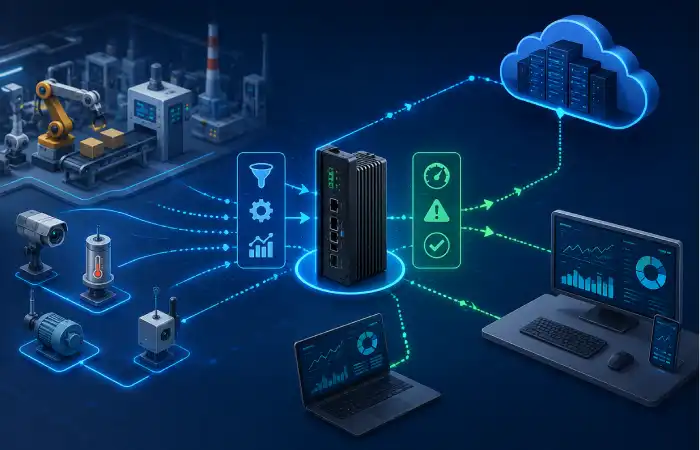
Edge computing brings data collection and data processing closer together.
Here is a flow for that basic structure:
An IoT sensor gathers data.
- The data is transmitted to an nearby edge device or gateway.
- The edge device process the data locally at that moment.
- Key decisions are made locally.
- Only useful filtered or summarized data is sent to the cloud.
This approach saves time and reduces unnecessary data transfer.
Example in Real Life
A smart security camera senses movement.
Without edge computing the camera must send video to the cloud, wait for the cloud to perform the analysis and then wait for the reply.
With edge computing the camera or the local hub performs immediate detection and triggers an alarm within seconds.
This time difference is important for security, healthcare and industrial systems.
Edge Computing Architecture in IoT
| Layer | Role |
| IoT Device Layer | Gathers unprocessed data using sensors and intelligent appliances |
| Edge Layer | Processes the data locally, eliminates noise and rapid decision making |
| Cloud Layer | Stores historical data, perform intensive analyses, and allow for remote access. |
In doing so a balanced distributed system is formed. The “edge” side is made for making rapid decisions, and the “cloud” is used for much larger computations.
Benefits of Edge Computing for IoT
The many practical benefits that Edge Computing can provide for the Internet of Things (IoT) are numerous, both in technical terms, and also from a business perspective.
1. Faster Response Time
Decisions are required very rapidly from IoT devices. Reducing the distance to travel for the data minimizes latency through edge computing.
This is important in:
- Autonomous vehicles
- Medical monitoring
- Factory control systems
- Security alerts
2. Lower Bandwidth Use
Not all raw data needs to go to the cloud. Filtering out unimportant data at the edges devices and only communicating essential data is now possible. This will save network resources and communication costs.
3. Enhanced Reliability
Edge devices are able to work locally and offline without needing to have a continuous connection, or stable connectivity to the internet. This means the system can still function, even if the cloud access is lost briefly.
4. Enhanced Privacy and Security
Data is not dispersed over all systems. Sensitive data can be processed locally. For example this could be used within home surveillance, home security and staff surveillance systems, home appliances, banking applications or in health care.
5. Reduced Cloud Dependency
Though cloud computing provides abundant processing power and flexibility, it could be costly and overloaded. Edge computing offloads tasks to devices local to the data source, thereby alleviating the strain on cloud resources.
6. Improved Scalability
More and more IoT devices are being added to our network and edge computing alleviates the problem without centralizing everything.
Benefit Summary Table
| Benefit | Why It Matters in IoT |
| Faster response | Supports real-time decisions |
| Lower bandwidth | Reduces data transfer costs |
| Better reliability | Keeps devices working during outages |
| Improved privacy | Limits exposure of sensitive data |
| Reduced cloud load | Makes systems more efficient |
| Easier scaling | Supports large IoT networks |
Edge Computing vs Cloud in IoT
Edge and cloud computing are often compared, but they are not enemies. They are better understood as partners.
Cloud is perfect for storage, Big Data analytics, machine learning, remotely access. Edge is perfect for immediate action, locally control, minimizing latency.
Comparison Table
| Feature | Edge Computing | Cloud Computing |
| Processing location | Near the device | Remote data centers |
| Speed | Very fast | Slower due to distance |
| Internet dependency | Low | High |
| Best for | Real-time decisions | Heavy analytics and storage |
| Bandwidth usage | Low | High |
| Privacy | Better local control | Depends on cloud security |
| Scalability | Great for distributed devices | Great for central management |
| Cost type | Local hardware investment | Cloud storage and service fees |
Which One Is Better?
The answer depends on the use case.
- When processing needs to happen fast and at the local level, use edge computing.
- When large volumes of storage, reporting, or complex analytics are required, use cloud computing.
- Use both together for the best IoT performance.
A Practical Example
In a smart agriculture system:
- The edge can detect soil moisture and trigger irrigation immediately.
- The cloud can collect months of data to identify seasonal patterns and improve farming strategy.
That combination gives both speed and intelligence.
IoT Edge Computing for Beginners
If you are new to this topic, the idea may sound technical at first. But the concept is actually easy to understand.
Think of IoT devices as the “senses” and edge computing as the “brain nearby.”
Instead of all of devices sending information a long distance away some thinking occurs local.
Beginner-Friendly Example
A smart thermostat measures room temperature.
- It does not need to ask the cloud every second whether the room is too hot.
- It can decide locally when to switch the AC on or off.
- Later, it may send usage data to the cloud for reports and analysis.
That is edge computing in action.
Key Things Beginners Should Know
| Concept | Simple Explanation |
| Latency | The time it takes data to travel and get a response |
| Gateway | A device that connects sensors to the network |
| Local processing | Handling data near the source |
| Data filtering | Removing unnecessary or repeated data |
| Real-time response | Acting immediately without cloud delay |
Easy Steps to Understand an IoT Edge System
- Sensors collect data.
- An edge device receives the data.
- The device filters and analyzes it.
- Immediate actions are taken locally.
- Cloud storage receives only important records.
That is the basic structure most beginner-level IoT edge systems follow.
Where Edge Computing Is Used in IoT
Edge computing is already part of many everyday and industrial systems.
Common Use Cases
| Industry | Example Use |
| Smart homes | Smart speakers, cameras, thermostats |
| Healthcare | Patient monitors, wearable health trackers |
| Manufacturing | Machine monitoring, predictive maintenance |
| Retail | Smart checkout, inventory sensors |
| Transportation | Connected vehicles, traffic systems |
| Agriculture | Soil sensors, automatic irrigation |
| Smart cities | Streetlights, observation devices, traffic management |
Why These Areas Need Edge Computing
These industries need to make fast decisions. Delays no matter how small are problematic
For example:
- A factory machine may fail if vibration is not detected quickly.
- A health monitor may need to alert doctors immediately.
- A smart traffic system may need to react in real time to prevent congestion.
These kinds of systems are made more robust and reactive with edge computing.
Challenges of Edge Computing in IoT
Like any technology, edge computing also has challenges. It is not a perfect replacement for cloud systems.
Main Challenges
| Challenge | Explanation |
| Hardware cost | Edge devices may require extra equipment |
| Device management | Many distributed devices are harder to monitor |
| Security risks | More endpoints can create more attack surfaces |
| Maintenance | Local systems need updates and support |
| Limited processing power | Edge devices are not as powerful as cloud servers |
Why These Challenges Matter
There could be hundreds, or even thousands, of edge nodes in a massive IoT network. Managing that many devices could be problematic. It’s also much more critical to provide a secure environment for them, since each node can be a potential access point for malicious activity.
That is why a strong IoT edge strategy needs monitoring, encryption, authentication, and regular updates.
Best Practices for Using Edge Computing in IoT
To get the most from edge computing, systems should be designed carefully.
Useful Practices
- Process only the most important data at the edge.
- Keep sensitive data local whenever possible.
- Use cloud storage for backup and long-term trends.
- Secure every device with authentication and encryption.
- Update edge firmware regularly.
- Monitor device health and performance.
- Design for offline operation where possible.
Why This Helps
A well-planned edge system stays fast, secure, and efficient. It also reduces the risk of overload, data waste, and downtime.
Edge Computing in IoT: A Simple Workflow Table
| Step | Action |
| 1 | IoT device captures data |
| 2 | Edge gateway receives the data |
| 3 | Local analysis filters useful information |
| 4 | Immediate action is taken if needed |
| 5 | Relevant data is sent to the cloud |
| 6 | Cloud stores and analyzes long-term patterns |
This workflow shows why edge computing is such a strong fit for IoT environments.
Why Edge Computing Matters for the Future of IoT
The evolution of IoT will not just about connecting more devices, but also about intelligent, fast and practical devices.
While IoT becomes more and more prevalent, transferring every byte of data to the cloud will turn inefficient, Edge computing resolves this issue by pushing intelligence close to the source of data.
This matters especially in situations where:
- Speed is critical
- Internet access is unstable
- Data privacy is important
- Many devices operate at once
- Real-time automation is needed
In many ways, edge computing is becoming the backbone of modern IoT design.
Final Thoughts
One of the leading concepts of the world of the IoT, edge computing, makes it faster, reduces the need for bandwidth, enhances reliability and enable real-time decisions. Although the cloud continues to be a crucial aspect in terms of storage and big data analytics, the edge has the capacity to make the entire IoT system much faster. Because IoT continues to grow in every sphere of our lives: the home, factory, hospital, farm and the smart city, the need for edge computing will increase.