
Last Updated: June 25, 2026
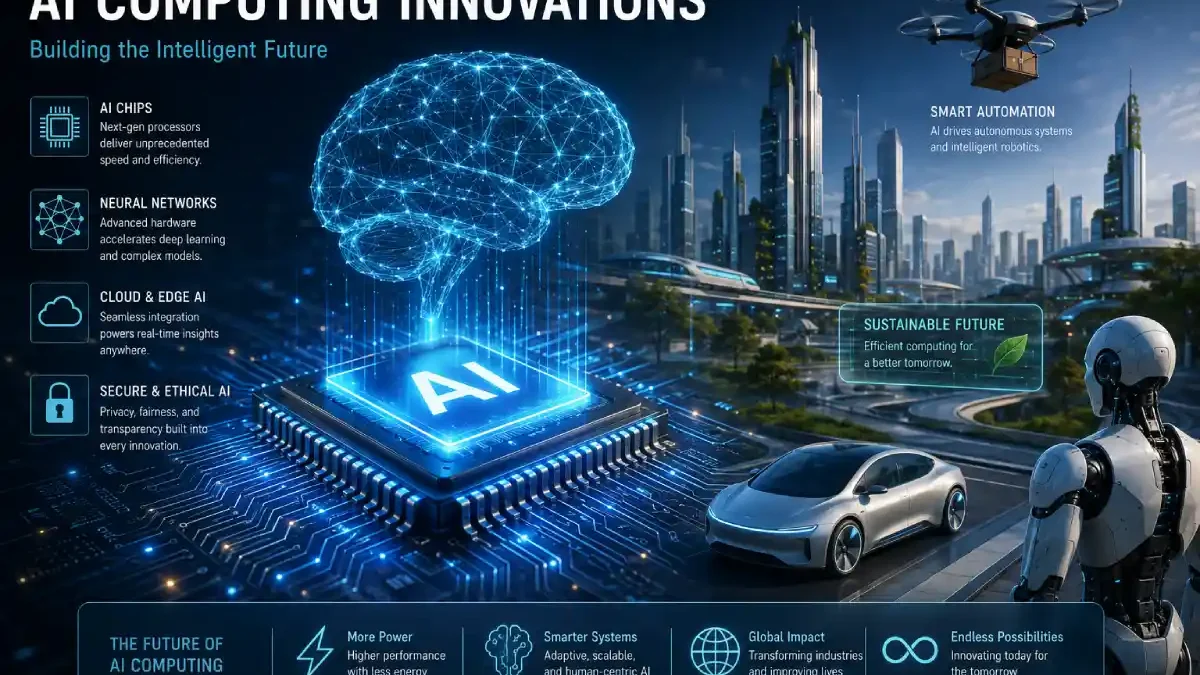
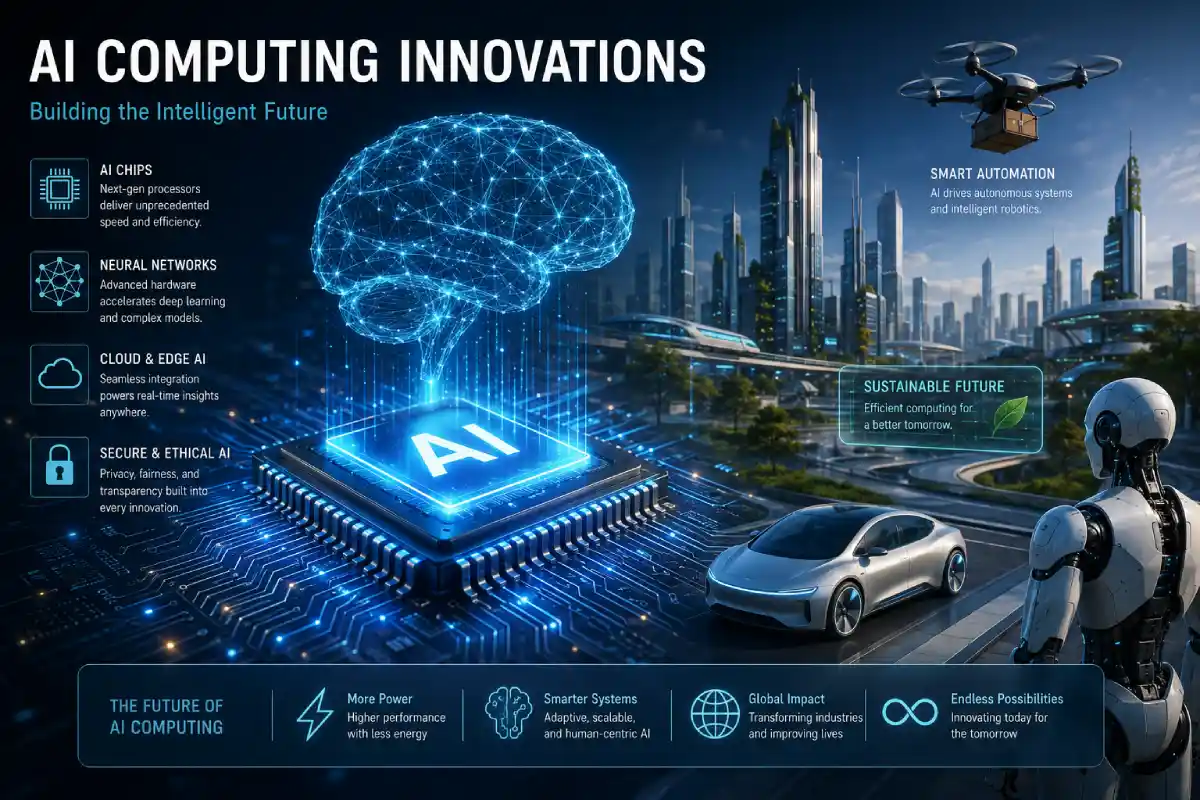
AI is no longer just a software story. It is becoming a hardware story too. But some of the largest changes appear to be occurring around design of chips, memory usage, connectivity of systems and also the increased level of AI that can run locally (not necessarily in the cloud). As can be seen in some of the recent official announcements from NVIDIA, Google and Intel, AI systems are moving towards compute stacks optimized for training, inference and on-device AI, that is also faster and more specialized.
Table of Contents
Latest AI Computing Breakthroughs
One of the biggest breakthroughs is the rise of large AI superchips built for massive parallel workloads. NVIDIA’s Blackwell architecture packs 208 billion transistors and uses two reticle-limited dies linked into one unified GPU with a 10 TB/s chip-to-chip interconnect. NVIDIA’s newer Blackwell Ultra continues that direction with a dual-reticle design, 208B transistors, and NVFP4 precision aimed at faster reasoning and better efficiency for large-scale AI deployments.
Google has pushed a similar trend with TPU v6e, also called Trillium. Google’s documentation says v6e is optimized for transformer, text-to-image, and CNN workloads, and the release notes highlight improvements such as over 4x training performance, up to 3x inference throughput, a 67% increase in energy efficiency, and higher compute per chip. That matters because modern AI is not just about raw speed; it is also about doing more work per watt and per dollar.
Intel itself has also been trying to drive its own AI stack forward. In 2025 Intel was increasing Gaudi 3’s availability for enterprise AI using an open Ethernet-based method for scalability. It also showed research on price and performance, positioning Gaudi 3 as a cost/performance competitor in inference workloads, and further in 2026 positioned Xeon 6+ within a agentic AI infrastructure layer focused on orchestrating data and scale.
Another major shift is the move toward AI PCs. Intel describes AI PCs powered by Core Ultra processors as devices that run AI directly on the PC, improving privacy, responsiveness, and efficiency. Intel’s material also explains that these systems distribute work across CPU, GPU, and NPU engines, with the NPU handling sustained low-power AI workloads and the CPU handling low-latency response.
Quick comparison of today’s AI hardware landscape
| Hardware type | Best for | Main advantage | Notable example |
| GPU | Training large models and high-throughput inference | Extremely strong parallel compute and memory bandwidth | NVIDIA Blackwell / Blackwell Ultra |
| TPU | Transformer-heavy cloud workloads | Purpose-built efficiency for ML at scale | Google TPU v6e (Trillium) |
| AI accelerator | Enterprise inference and scalable deployment | Open networking and workload-focused design | Intel Gaudi 3 |
| CPU | Orchestration, control plane, and low-latency tasks | Flexibility and system coordination | Intel Xeon 6+ |
| NPU | Always-on local AI tasks on laptops | Low power use for sustained AI workloads | Intel Core Ultra AI PC platform |
AI Chips and Processors Explained
AI chips need to do one thing very efficiently: move and multiply masses of data at an extreme rate. On its face, that appears easy, but in reality the challenges involved are in balancing compute, memory, bandwidth, thermal output and power consumption. While general-purpose CPUs are suited for most computational needs, much of the workload in AI relies heavily on massive parallel matrix computations, hence the increasing relevance of GPUs, TPUs, and other accelerators.
GPUs are generally the first port of call for massive model training, with parallel computations being one of their defining features. NVIDIA’s Blackwell family architecture provides just one example: a dual-die design with extreme interconnect speed and an upgraded Transformer Engine to optimize performance when processing massive language and mixture-of-experts workloads. Blackwell Ultra pushes this further with 160 SMs and 5th-generation Tensor Cores, showing how far AI-specific GPU design has evolved.
TPUs take a different route. Instead of being broadly general-purpose, they are custom-built for machine learning workloads. Google’s TPU v6e documentation says the system is optimized for transformer, text-to-image, and CNN training, fine-tuning, and serving. The release notes also highlight higher energy efficiency and improved throughput, which is a reminder that AI infrastructure is now judged on both speed and sustainability.
The Gaudi 3 from Intel is also an interesting choice as it offers more openness, coupled with Ethernet scaling. The company claims that the Gaudi 3 is designed for use cases involving large language models, multimodal models and RAG applications for the enterprise, in such a way as to side-step certain proprietary networking constraints. That’s quite an approach and will appeal to organizations concerned about integration, cost and their current data-center environment.
Here is a simple way to think about the chip choices:
| Chip family | Typical role | Why teams choose it |
| CPU | Control and coordination | Best for general tasks, scheduling, and latency-sensitive work |
| GPU | Heavy AI compute | Best when the model is large and the workload is highly parallel |
| TPU | Cloud ML specialization | Best when the stack is designed around ML efficiency from the start |
| NPU | Local AI on devices | Best for battery-friendly, always-on AI features |
| AI accelerator | Enterprise deployment | Best when scale, openness, and economics matter together |
Neural Network Hardware Innovations
The most exciting progress is not just “faster chips.” It is smarter hardware design. One big innovation is low-precision computing. NVIDIA’s Blackwell Ultra introduces NVFP4, a precision format built to reduce memory footprint while maintaining strong accuracy for AI workloads. This matters because lower precision usually means less memory traffic, lower energy use, and faster inference.
Another major theme is chiplets and unified die design. Blackwell connects two dies together into a single GPU. Designers are no longer locked into one huge monolithic die in order to scale performance. This monolithic design is likely to see wider adoption as a) today’s AI chips require extreme compute density and b) must still be manufactured economically, at power, and at scale.
Memory is just as important as compute. Google’s TPU v6e documentation and release notes call out increased HBM capacity and doubled interchip interconnect bandwidth. In AI systems, memory is often the bottleneck, not math itself, so bigger and faster memory systems can make a surprisingly large difference.
There is also growing interest in compute-in-memory. A compute-in-memory system tries to reduce the cost of moving data back and forth between memory and processor by doing some of the math closer to where the data lives. A DNN+NeuroSim paper describes compute-in-memory accelerators as a benchmarking framework for deep neural networks and highlights evaluation of area, energy efficiency, throughput, and training accuracy under hardware constraints. That idea is important because the future of AI hardware may depend on reducing data movement as much as increasing raw compute.
What these hardware innovations solve
| Innovation | Problem it solves | Why it matters |
| Low precision formats | Too much memory use and energy waste | Makes inference and training faster and cheaper |
| Chiplets / dual-die designs | Limits of giant single-die chips | Lets vendors scale performance more efficiently |
| Bigger HBM and interconnects | Data bottlenecks in large models | Helps large workloads stay fed with data |
| Compute-in-memory | Expensive data movement | Can improve energy efficiency and throughput |
| CPU+GPU+NPU division | One engine cannot do everything well | Makes local AI smoother and more power efficient |
How AI is Changing Computing
AI is changing computing in two directions at once. First, it is changing how we build computers. Second, it is changing what computers are expected to do. On the hardware side, computers are becoming more specialized, with chips designed around model training, inference, and local AI features rather than just general-purpose speed. On the software side, AI is starting to sit inside the tools people use every day, from writing assistants to image generation to coding help.
In the data center, AI is pushing systems to act more like coordinated factories. NVIDIA describes Blackwell Ultra as part of the “AI factory era,” while Intel’s 2026 messaging about Xeon 6+ says that agentic AI puts orchestration, concurrency, and data movement back at the center of infrastructure planning. That means the old idea of “just buy a faster chip” is no longer enough; the whole system has to work as a unit.
On personal devices, AI is becoming quieter and more private. Intel’s AI PC materials say models can run directly on the device, which helps reduce dependence on browser-based tools and can keep data more secure. The Intel AI PC material also points to tasks like drafting emails, editing images, and generating music or text right on the local machine. That is a big shift from the earlier era when serious AI almost always meant sending everything to the cloud.
In business settings, that shift also affects procurement. Intel’s Gaudi 3 messaging focuses on open source flexibility, standard Ethernet, and simpler scaling, while Google’s TPU materials emphasize performance per dollar and energy efficiency. In other words, AI computing is becoming a balancing act between performance, cost, and operational simplicity.
Future of AI Computing
The future of AI computing will likely be defined by three things: smaller energy footprints, tighter hardware-software integration, and more AI happening close to the user. The trajectory in current hardware announcements points toward systems that are better at specific AI jobs rather than systems that try to do everything equally well.
We should expect more low-precision formats, more chiplets, more advanced memory systems, and more hardware tuned for inference rather than just training. NVIDIA’s Blackwell Ultra already shows how precision formats and unified dies can lower cost and raise throughput, while Google’s TPU v6e shows how cloud accelerators are being optimized for efficiency and scale. Intel’s AI PC and Gaudi 3 work suggest that the future is not one single device class, but a layered ecosystem: cloud for the heaviest workloads, local devices for fast and private tasks, and enterprise accelerators in between.
Another likely direction is the rise of “AI everywhere” computing. Intel’s AI PC and Xeon 6+ announcements show the CPU still matters, especially for orchestration and data movement. That is an important reminder: the future of AI hardware is not about replacing every chip with one superchip. It is about making every layer of the stack smarter and more specialized.
Final Thoughts
AI computing innovations are reshaping the entire technology stack. Chips are becoming more bespoke, memory is taking a more strategic role, and the viability of local AI is improving monthly. The upshot is a computing landscape that has begun to resemble a tightly managed collection of engines rather than a single machine-each performing the task it is best suited for. This is the core of the innovation.