
Last Updated: September 23, 2026
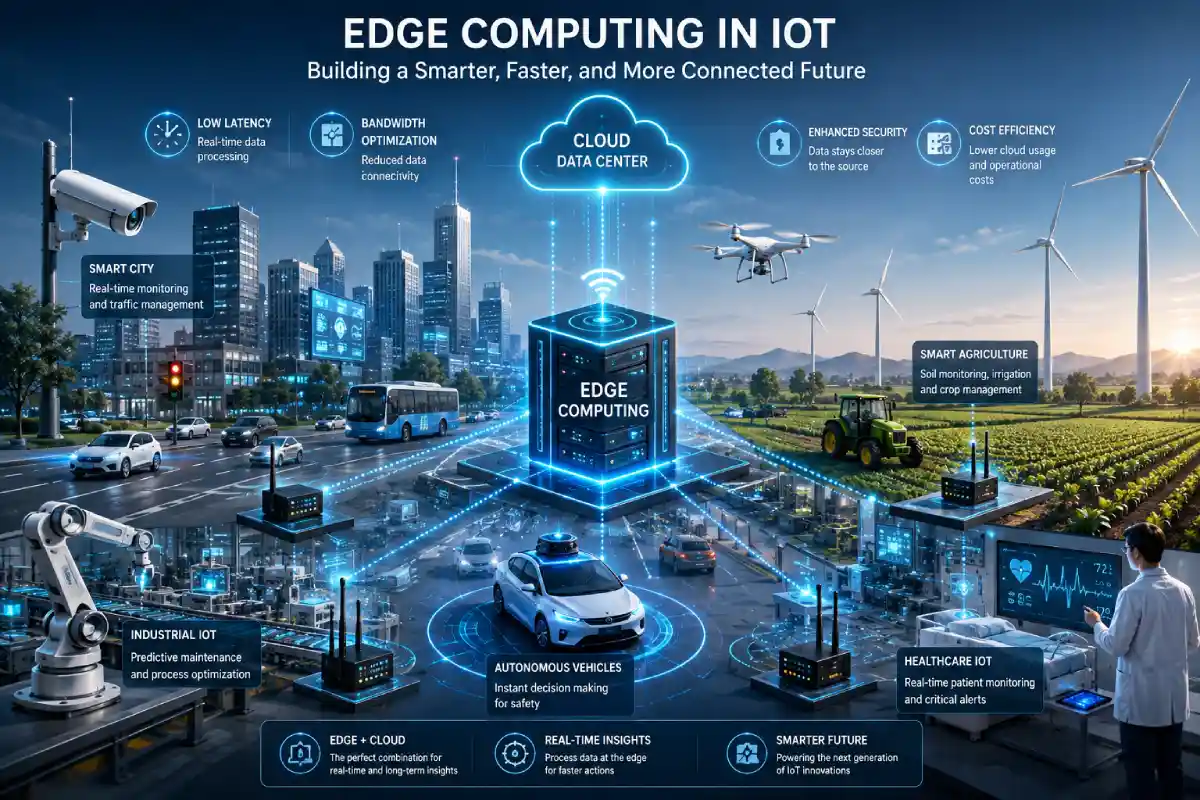
IoT is already making big waves on the way that we live, work and interface with machines. If there’s an ‘Internet of Things’ then everything that we see, experience or interact with from a smart home and wearables to factory sensors and connected cars is an IoT device. The more IoT devices the more data generated and sending all of it to a cloud is prone to latency issues, congestion, and security threats.
This is where edge computing for IoT has been developed to solve.
Edge computing is simply where data processing takes place much closer to the origin. This will enable IoT devices to respond much more quickly, intelligently and with real-time intelligent processing power. Rather than just the reliance of a remote cloud; the data will instead be processed on edge device or gateway close to the data origin.
This article belongs to Internet of Things
Table of Contents
What Is Edge Computing in IoT?
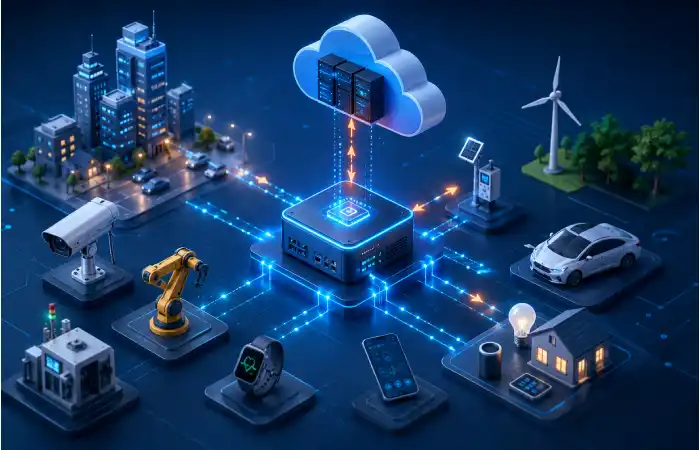
Edge computing in IoT refers to a computing architecture in which data processing is performed closer to the source it is generated at, rather than at a central cloud data center.
In an IoT device arrangement sensors or devices generate data about movement, sound, pressure, sound, temperature, or machine condition, which is then immediately analyzed locally by any nearby devices, on-premises servers, or local gateways.
Definition:
It’s called edge computing when data generated by IoT devices are processed at or near the source. This helps to decrease latencies, save bandwidth, as well as enables real-time decision-making.
This approach is especially useful when:
- speed matters
- internet connectivity is weak or unstable
- large volumes of data are being created
- privacy and security are important
- immediate action is needed
Consider a smart traffic control system: an edge computer could immediately detect traffic jams from the camera and change signals without needing cloud commands. Consider a factory machine: a sensor can find out a fault occurs in the machine and make an alarm in milliseconds.
Why Edge Computing Matters in IoT
The primary purpose of IoT devices is to acquire and transmit information. The cloud only approach gradually becomes incapable of satisfying requirements as more IoT devices get deployed.
The reasons for edge computing are as follows:
1. Faster Response Time
Device can avoid sending all requests to the cloud if it can deal with the data itself. The delay can be eliminated and real time reaction can be achieved.
2. Reduced Network Traffic
IoT devices are able to produce vast amounts of data in every second. Edge computing processes and filters this data so that only relevant data is transmitted to the cloud. This saves network bandwidth and network congestion.
3. Better Reliability
Edge devices can continue to work locally, even with an unsteady internet connection. This is critical in factories, hospitals, farms in rural areas, and cars.
Improved Security and Privacy
Sensitive data can remain closer to the source without having to be transferred across networks many times. This can also minimize the exposure to cyber risks.
Lower Cloud Costs
Organizations will also benefit from operational cost savings since less raw data needs to be sent and stored on the cloud..
How Edge Computing Works in IoT
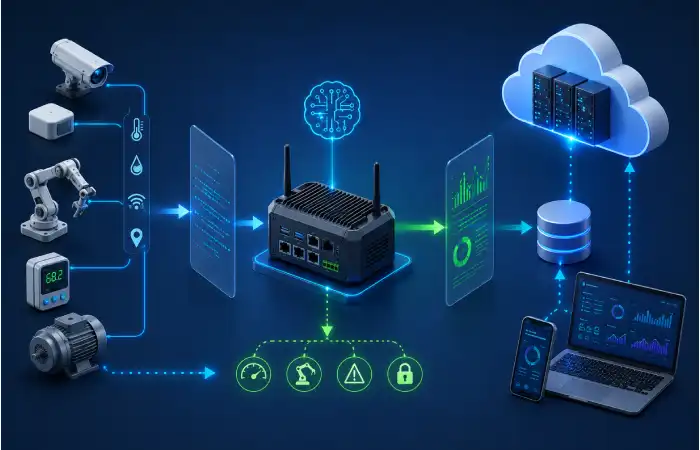
The process usually follows a simple flow:
1. IoT devices collect data
Sensors and connected devices gather information from the environment.
2. Edge layer processes data locally
Nearby edge gateways, routers, micro data centers, or edge servers analyze data at the source.
3. Important data is sent to the cloud
Only useful, filtered, or summarized information is sent to the central cloud for long-term storage, analytics, or reporting.
4. Action is taken
Based on the analysis, the system responds automatically or notifies a user.
This layered structure helps balance speed, storage, and intelligence.
Edge Computing IoT Devices
Edge computing IoT devices are the smart devices or systems that can perform some level of processing close to where data is collected.
These devices may include:
- smart sensors
- industrial controllers
- gateways
- routers with computing capability
- cameras with embedded AI
- wearable devices
- smart appliances
- autonomous machines
- local mini servers
Features of Edge IoT Devices
| Feature | Description |
| Local processing | Handles data on or near the device |
| Low latency | Responds quickly without cloud delay |
| Connectivity support | Communicates with cloud and other devices |
| Security controls | Reduces exposure of sensitive data |
| Energy efficiency | Can optimize power use by reducing unnecessary transmissions |
Examples of Edge IoT Devices in Real Life
| Sector | Edge Device Example | Function |
| Smart home | Smart thermostat | Adjusts temperature locally |
| Healthcare | Wearable health monitor | Detects abnormal heart rate instantly |
| Manufacturing | Vibration sensor | Identifies equipment failure early |
| Retail | Smart camera | Tracks footfall and behavior |
| Agriculture | Soil sensor | Sensing moisture and irrigation requirements |
These are very important because they enable the systems to make smart decision in real time instead of relying on the cloud to do that.
Edge AI in IoT
One of the greatest developments in the world of IoT is that of edge AI.
Edge AI in IoT refers to the artificial intelligence models running on edge devices or edge servers. In essence, the device can identify patterns, detect anomalies or predict them itself, rather than having to transmit data to the cloud for analysis by AI.
This is of particular interest when an immediate decision is required.
Definition:
Edge AI in IoT is the use of AI algorithms on edge devices to analyze data locally and produce intelligent decisions with very low delay.
Why Edge AI Is Important
- It enables real-time intelligence.
- It reduces dependence on cloud connectivity.
- It improves privacy by keeping data local.
- It supports offline or low-network environments.
- It reduces cloud processing costs.
Common Uses of Edge AI in IoT
| Use Case | Edge AI Function |
| Smart surveillance | Detects suspicious movement instantly |
| Predictive maintenance | Identifies machine wear before failure |
| Healthcare monitoring | Detects abnormal patient patterns |
| Autonomous vehicles | Processes sensor data in real time |
| Retail analytics | Knows how the customers move about and where they go |
| Smart agriculture | Forecasts crop water stress/ irrigation |
Simple Example
With a factory camera using edge AI you would be able to inspect products as they came down the line and instantly reject those with faults. If the data instead had to be sent up to the cloud and back this would result in a more delayed and inefficient response time.
Edge AI is changing the role of IoT devices from data collection machines into “decision makers”.
Edge Computing for Industrial IoT
IIoT is one of the best use cases for edge computing. Machine safety, high availability and up-time, rapid response and machine safety are all aspects of an industrial setting that demand quick processing of information.
Definition:
Edge computing for industrial IoT refers to local data processing in factories, plants, warehouses, and industrial systems to support real-time automation, monitoring, and control.
Why It Fits Industrial Systems So Well
Industrial equipment continuously generates an ongoing stream of information. Machines, robotic arms, conveyers, pressure monitors, temperature devices, quality control systems etc are all useful in the form of a signal.
Sending every signal to the cloud can cause delays. In industries, even a small delay can create:
- machine damage
- production loss
- safety risks
- quality issues
- higher operating costs
Edge computing solves this by allowing local systems to react instantly.
Industrial IoT Use Cases
| Industrial Scenario | Edge Computing Benefit |
| Predictive maintenance | Detects faults early before equipment breaks |
| Factory automation | Controls machines with low latency |
| Quality inspection | Identifies defects in real time |
| Energy management | Optimizes power use locally |
| Worker safety | Sends instant alerts for dangerous conditions |
| Remote plant operations | Keeps systems running even with poor connectivity |
Example in Industry
Edge sensors can be utilized in packaging factories to keep track of speed, temperature, vibration, and alignment. In the event that one of the machines starts to vibrate abnormally, the edge system can then shut it down before it breaks, saving money on downtime and repair costs.
Why Industrial Leaders Prefer Edge
Industrial leaders value reliability, speed, and control. Edge computing offers all three. It also helps organizations maintain operations even in remote or harsh environments where cloud dependency may not be practical.
Edge vs Cloud IoT
Many people assume edge computing replaces the cloud. That is not true. In most modern IoT systems, edge and cloud work together.
The cloud is still excellent for large-scale storage, historical analytics, dashboards, and model training. The edge is better for fast action, local intelligence, and reducing network pressure.
Comparison Table: Edge vs Cloud IoT
| Feature | Edge IoT | Cloud IoT |
| Data processing location | Near the device | Remote data center |
| Speed | Very fast | Slower due to transmission delay |
| Internet dependency | Low | High |
| Bandwidth usage | Low | High |
| Scalability | Good for distributed systems | Excellent for centralized storage |
| Real-time decisions | Strong | Limited by latency |
| Privacy | Better, because data stays local | More data moves outside the device |
| Cost model | Local hardware investment | Cloud storage and compute costs |
| Best for | Automation, response, local intelligence | Analytics, storage, reporting |
Edge vs Cloud: When to Use Each
| Situation | Better Choice |
| Instant machine shutdown | Edge |
| Long-term data archiving | Cloud |
| Remote health monitoring | Edge + Cloud |
| Global analytics dashboard | Cloud |
| Video analytics at a site | Edge |
| AI model training on large datasets | Cloud |
The Best Approach: Hybrid IoT
For most organizations, the smartest setup is a hybrid model. In this model:
- The edge handles immediate tasks
- The cloud handles storage, deep analytics, and system-wide insights
This gives businesses the best of both worlds.
Benefits of Edge Computing in IoT
Edge computing adds value in many ways. Here are the biggest benefits in practical terms.
1. Real-Time Decision Making
Devices can act instantly when conditions change.
2. Better User Experience
Smart systems feel more responsive and dependable.
3. Less Data Transfer
Only the most relevant data goes to the cloud.
4. Stronger Performance in Remote Areas
Allows systems to continue to function without relying on internet connectivity.
5. Saves Power & extends life span of devices
Sending fewer amounts of data saves power and life.
6. Smarter Automation
Local intelligence supports automatic actions without human delay.
Challenges of Edge Computing in IoT
Although edge computing is powerful, it is not perfect. It comes with a few challenges that organizations must consider.
1. Hardware Complexity
Edge systems may need specialized chips, gateways, or mini servers.
2. Device Management
Managing many distributed edge devices can be more complex than managing one central cloud system.
3. Security at the Edge
Despite local data storage, the edge device itself can be compromised.
4. Maintenance
More hardware means more maintenance, updates, and monitoring.
5. Limited Resources
Edge devices may not have the same storage or processing power as cloud systems.
6. Integration Difficulty
Architecture to integrate the edge, cloud, sensors and apps seamlessly is often key.
Architecture of Edge Computing in IoT
A typical edge-enabled IoT architecture includes several layers.
A deeper look at edge computing in IoT architecture explains how device, edge, network, cloud, and application layers work together.
| Layer | Role |
| Device layer | Collects data using sensors and actuators |
| Edge layer | Processes data locally and makes quick decisions |
| Network layer | Transfers data between devices, edge, and cloud |
| Cloud layer | Stores data, performs deep analytics, manages dashboards |
| Application layer | Presents insights to users and systems |
This structure makes IoT systems more flexible and efficient.
Real-World Applications of Edge Computing in IoT
Edge computing is not only a technical idea. It is already being used in many industries.
Smart Cities
Edge computing plays an important role in traffic lights, surveillance, waste management sensors, parking systems to speed up responses and alleviate traffic.
Healthcare
Devices that you wear and patient monitors have the ability to identify anomalous patterns on the spot, allowing doctors to act quicker.
Manufacturing
Factories use edge devices for automating processes, inspections, robots, and preventive maintenance.
Agriculture
Edge computing aids farmers to better decisions for soil sensors, smart irrigation and weather station system.
Transportation
Connected vehicles and fleet systems rely on edge processing for navigation, safety, and diagnostics.
Retail
Stores are using edge-enabled cameras and sensors to monitor inventory, customer movement and efficiency at the checkout.
Table: Edge Computing in IoT by Industry
| Industry | Main Use | Edge Advantage |
| Healthcare | Patient monitoring | Fast alerts and privacy |
| Manufacturing | Predictive maintenance | Low downtime |
| Agriculture | Smart irrigation | Local field decisions |
| Transportation | Vehicle monitoring | Instant safety response |
| Retail | Customer analytics | Real-time insight |
| Smart cities | Traffic control | Faster public service response |
How Edge Computing Improves Security in IoT
Security is a major concern for IoT because of the vast numbers of devices being connected to the Internet.
Edge computing helps in several ways:
For additional guidance on securing connected devices, the NIST Cybersecurity for IoT Program provides standards and guidance for managing cybersecurity risks across IoT systems and products.
- It keeps sensitive data local.
- It reduces the number of times data travels across networks.
- It allows quicker threat detection.
- It can isolate risks to a smaller network zone.
However, edge systems still need protection through:
- encryption
- authentication
- software updates
- access control
- secure device management
A strong IoT system does not depend on one layer of security alone. It uses protection at every layer.
The Future of Edge Computing in IoT
More and more the future of IoT appears intertwined with that of edge computing. The ability to analyze massive amounts of data, with greater intelligence in each device and more of them as well, will likely lead to the necessity of computing that responds in real time, and functions even without stable cloud connectivity.
Many different factors are contributing to this trend.more edge AI adoption
- smarter chips and low-power processors
- 5G and improved connectivity
- increased use of autonomous machines
- growth in industrial automation
- wider deployment of digital twins and real-time analytics
Over the next few years I think it’s quite probable that edge computing will be the norm for almost any credible IoT solution.
Relationship Between 5G and Edge Computing
Edge computing is rapidly increasing in popularity in IoT because of the implementation of 5G.
How 5G Supports Edge Computing
| Feature of 5G | Benefit for Edge Computing |
| Ultra-low latency | Faster real-time communication |
| High bandwidth | Supports large-scale IoT deployments |
| Massive device connectivity | Connects millions of devices simultaneously |
| Reliable communication | Enhances mission-critical applications |
| Network slicing | Optimizes resources for different use cases |
Combining 5G and edge computing enables to optimize efficiency and robustness for applications such as autonomous vehicles, smart factories and remote healthcare.
Role of Edge Computing in Smart Cities
For Smart cities, the infrastructure is huge network of interconnected devices which is continuously collecting data from city.
Examples of Smart City Applications
- Intelligent traffic management
- Smart parking systems
- Environmental monitoring
- Public safety surveillance
- Smart street lighting
- Waste management systems
Benefits in Smart Cities
| Application | Edge Computing Advantage |
| Traffic control | Instant signal adjustments |
| Public safety | Real-time threat detection |
| Air quality monitoring | Immediate environmental alerts |
| Smart lighting | Automatic energy optimization |
| Parking systems | Faster space availability updates |
Edge computing allows city infrastructure to react instantly instead of waiting for cloud-based instructions.
Edge Computing and Data Analytics
Data analytics is one of the most important functions in IoT systems.
Traditionally, analytics occurred entirely in the cloud. However, edge computing enables real-time analytics directly at the source of data generation.
Types of Analytics at the Edge
| Analytics Type | Purpose |
| Descriptive Analytics | Understand current conditions |
| Diagnostic Analytics | Identify causes of issues |
| Predictive Analytics | Predict the future |
| Prescriptive Analytics | Propose measures |
A manufacturing sensor can predict potential equipment failures before they happen. This enables maintenance workers to be preventative.
Edge Computing Architecture Layers
An overall, strong architecture of edge enabled IoT would consist of a number of layers.
1. Device Layer
This layer includes:
- Sensors
- Cameras
- Smart meters
- Wearables
- Industrial machines
Its primary role is data generation.
2. Edge Layer
This layer processes data locally through:
- Gateways
- Edge servers
- Embedded processors
Functions include:
- Filtering data
- Running AI models
- Making real-time decisions
3. Network Layer
This layer handles communication between devices, edge infrastructure, and cloud services.
4. Cloud Layer
The cloud performs:
- Long-term storage
- Advanced analytics
- AI model training
- Reporting
5. Application Layer
This layer provides dashboards, alerts, reports, and user interfaces.
Edge Computing Security Best Practices
For a more detailed security perspective, explore edge security and the practices used to protect distributed edge infrastructure.
While edge computing will have an increased security due to physical closeness, security protocols need to be enforced correctly.
Security Recommendations
| Security Measure | Purpose |
| Data encryption | Keeps the information safe when it is being moved |
| Multiple-factor authentication | Stops others from getting in |
| Secure boot mechanisms | Protects devices during startup |
| Regular firmware updates | Fixes vulnerabilities |
| Network segmentation | Limits cyberattack spread |
| Intrusion detection systems | Identifies suspicious activities |
Common Security Threats
- Device tampering
- Malware attacks
- Unauthorized access
- Data interception
- Distributed Denial-of-Service (DDoS) attacks
In short, a holistic security approach is required for all edge deployments.
Advantages of Edge Computing Over Traditional Systems
Performance Comparison
| Factor | Traditional Cloud-Only IoT | Edge-Enabled IoT |
| Response Speed | Moderate | Very Fast |
| Network Dependency | High | Low |
| Real-Time Processing | Limited | Excellent |
| Bandwidth Usage | High | Reduced |
| Reliability | Depends on internet | More resilient |
| Scalability | Good | Excellent |
This provides a clear explanation why many enterprises are migrating towards edge-enabled infrastructure.
Edge Computing in Healthcare IoT
In the domain of Healthcare, edge computing looks like a growing area of opportunity.
Medical equipment produces sensitive data, which is sometimes time-critical and has to be analyzed quickly.
Healthcare Applications
- Patient monitoring
- Smart medical devices
- Remote healthcare
- Emergency response systems
- Hospital equipment management
Benefits
| Healthcare Function | Edge Benefit |
| Heart monitoring | Instant alerts |
| Medical imaging | Faster analysis |
| Wearable devices | Real-time health tracking |
| Emergency systems | Reduced response times |
| Patient privacy | Localized data processing |
When dealing with critical issues, seconds matter.
Edge Computing in Agriculture
IoT devices are being widely adopted to monitor and control activities in modern agriculture..
Agricultural Edge Applications
- Soil moisture monitoring
- Smart irrigation systems
- Livestock tracking
- Weather monitoring
- Crop health analysis
Benefits for Farmers
| Application | Benefit |
| Irrigation control | Water conservation |
| Crop monitoring | Higher yields |
| Weather tracking | Better planning |
| Livestock management | Improved animal health |
| Pest detection | Faster intervention |
Farmers utilize edge computing in order to quickly, accurately, and appropriately make their decisions, and they are able to do so without relying on the cloud as a continuous connection.
Environmental Impact of Edge Computing
The improvement of sustainability using Edge Computing relies on the reduced amount of traffic in the unnecessary part of network and saving the electricity.
Environmental Benefits
- Lower network energy consumption
- Reduced data center workload
- Efficient energy management
- Improved resource allocation
- Reduced carbon footprint
The area where most sustainability focused companies currently see an element of their green IT is with edge computing.
Future Trends in Edge Computing and IoT
The following are a number of developing trends anticipated for the future of edge computing.
1. Edge AI Expansion
More AI will be executing directly on devices, enabling sophisticated automation.
2. Rise of Autonomous Systems
Autonomous cars, robots and drones will take advantage of edge computation.
3. Acceleration of Industrial Automation
Factories will increase deployment of edge devices to production floor.
4. Micro Data Centers
Smaller localized data centers will become more common.
5. Digital Twins
Real-time virtual representations of physical systems will use edge-generated data.
6. Smart Infrastructure
It’s clear thatedge intelligence will be applied more and more in the use of buildings, cities, and transportation systems.
Key Statistics About Edge Computing in IoT
| Metric | Impact |
| Lower latency | Faster real-time decisions |
| Reduced bandwidth use | Lower network costs |
| Improved uptime | Better business continuity |
| Enhanced security | Reduced data exposure |
| Faster analytics | Immediate operational insights |
This is the main driver for rapid adoption of edge computing as an emerging hot topic in the IoT world.
Frequently Asked Questions
What is edge computing in IoT?
For a broader introduction, explore these edge computing in IoT basics covering the core concepts and benefits of processing IoT data closer to its source.
Edge computing means that IoT data processing occurs closer to where it is generated, and therefore, rapid and more responsive decisions are enabled.
Why is edge computing useful for IoT?
This is due to its speed which can improve reliability as well as reduce delays, and also increase efficiency. It also saves bandwidth, and enable real-time automation.
What are edge computing IoT devices?
For a closer look at the hardware involved, see this guide to edge computing IoT devices and hardware, including the components that enable local processing.
Examples include smart sensors, gateways, and controllers and cameras that are able to make data processing decisions nearby their location.
What is edge AI in IoT?
The combination of AI and machine learning with edge infrastructure is explored further in edge computing AI and ML, where local intelligence enables faster IoT analysis and decision-making.
It is artificial intelligence on edge devices, enabling intelligent analysis of data as well as local decisions.
Is edge computing better than cloud computing in IoT?
Not necessarily, edge is generally better for rapid decisions and local controls, whereas the cloud is better for larger storage, and analysis. A lot of systems integrate the two.
Final Thoughts
Edge computing is the technology behind this evolution of IoT where more and more intelligence closer to IoT devices. With the ever growing number of IoT devices connected, Businesses needs more processing, latency, security, and also efficiency from these networks and edge computing enables all that, while supplementing cloud power.
Applications from Smart cities, Healthcare, Retail, Farming, Manufacturing and transport are using edge computing. Paired with AI, ML and 5G technology, edge computing is empowering a new generation of intelligence everywhere.
With the ever growing need for data to be analyzed at scale and at a real-time pace, edge computing will continue to be a necessary part in shaping the future of nearly all industry.