
Last Updated: September 23, 2026
Computing innovation is now the driving force behind how the world works, communicate, learn, build and solve issues. Starting from room-sized early computers, all the way to the now “intelligent” systems that recognize our speech, recommend us what we watch on Netflix, detect what we do and do not do with our bank account, or help us in diagnose diseases, is truly a marvel to think about. What once required entire rooms and many skilled engineers now only require a single small chip inside of your mobile phone or a smart device.
This article belongs to Future Computing
The essence of computing innovation is the discovery of better systems, tools, methods, and technologies which makes computers to be smaller, faster, smarter, more useful and more energy efficient. These innovations are found not just in the laboratories of computer science or large technology companies, but also in our lives at school, in the hospital, in our bank accounts, in the factories, in our cars, homes, on the farm and even in the entertainment industry.
The necessity of computing innovation can be clearly seen from looking at the daily life. We use cloud to store our data, we use artificial intelligence for faster search, we use cyber security to protect ourselves from various issues and we use smart devices to makes our life easier and smarter. Corporations use computing technology to develop more automation and analytical tools. Scientists use computation to simulate the climate patterns, discover genes and discover new drugs and medicine. Student use computing based platforms to gain new knowledge and study better. In a single word, it is no longer the supporting system but it is the core.
Table of Contents
What Is Computing Innovation?
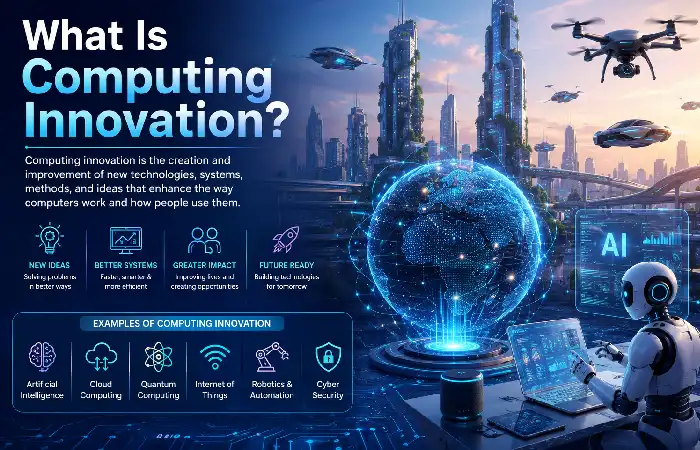
Computation innovation is any of various new or better technologies, systems, process, methods that improve how computers function or how humans use them, it can be a quicker processor, more intelligent algorithm in software, a new paradigm for programming, a new class of computer architecture.
Definition
Computing innovation means the introduction of new hardware, software, systems, and computation techniques that make digital technology better-faster, smarter, more connected, and easier to use.
While the definition sounds quite technical, the idea is actually quite basic. Simply put, anytime a computer is better able to process data, solve problems, and help people in a new way it is a computing innovation.
Why Computing Innovations Matter
Computing innovations matter because they:
- make devices faster and more powerful
- help people work and communicate more efficiently
- support scientific discovery and medical research
- improve business decision-making
- create new industries and job opportunities
- make technology more accessible and user-friendly
- solve problems that were once too large or too complex
This implies that the computing revolution is not merely about machinery, it’s about progress and convenience and possibility.
The Evolution of Computing
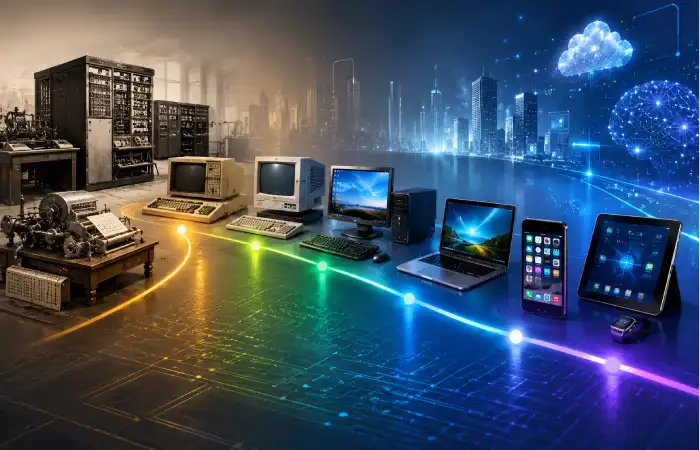
Before touching upon what is newest and currently exciting, it may be beneficial to outline how far computing has journeyed.
Early Computing Era
These early computers were massive calculation and military/science machines; they were slow, extremely expensive, and have an almost infinitesimally small amount of storage capability compared to modern machines.
Personal Computer Revolution
Personal computers moved computing into homes, schools and offices. This was massive! Users were able to compose documents, calculate data, store information and perform programs without use of a large machine.
Internet and Connectivity Era
Everything was transformed when the internet happened. Computing became global and connected. Interactive computers became possible through email, search engines, and websites. Online commerce was also facilitated. Computers became networked.
Mobile and Cloud Era
Portable devices such as smartphones and tablets and services like the cloud allowed people to carry out their computing on the move and in any location. Data and processing power was shifted out from the device onto remote cloud infrastructure.
Intelligent and Autonomous Era
Computing today is also getting smarter. Intelligence in AI, Machine learning, automation, edge computing and enhanced data systems are enabling computers to learn, predict and aid with an astonishing speed.
Latest Computing Technology
In terms of computing, current technology includes those most capable tools and systems affecting our world in a number of ways. They serve to boost efficiency, accuracy, flexibility and the overall experience the user has.
1. Artificial Intelligence and Machine Learning
AI and machine learning are perhaps the strongest computing advances in this era. They enables computers to learn from data, recognize patterns, predict future events, and automate decisions.
For additional information on AI research, standards, and emerging AI technologies, see the NIST Artificial Intelligence resources from the National Institute of Standards and Technology.
They are used in:
- voice assistants
- fraud detection
- recommendation engines
- medical diagnostics
- autonomous vehicles
- customer service chatbots
- predictive maintenance
Artificial intelligence is no longer a far-flung fantasy. It is an ever-present part of every day life.
For a deeper look at how AI is changing the way computers process information and perform tasks, explore these AI computing innovations.
2. Cloud Computing
When storing data and applications online rather than on your own device alone it essentially translates into Elasticity, Scalability and Cost-effectiveness for customers and companies respectively.
Advantages of cloud computing access from anywhere:
- easy data backup
- scalable storage and computing power
- reduced hardware costs
- better collaboration
For more information about this area of computing, see these cloud computing innovations
3. Edge Computing
Edge computing processes the data close to its source, it doesn’t transmit everything to a remote cloud. This speeds up processing and lowers latency.
It is especially useful in:
- smart cities
- industrial automation
- healthcare monitoring
- autonomous vehicles
- Internet of Things devices
The development of edge computing innovations is helping bring processing closer to connected devices and real-world data sources.
4. Quantum Computing
Quantum computing applies quantum mechanics to accelerate certain kinds of computation, much faster than on traditional machines. Although it’s still a developing field, there is great potential in cryptography, drug design, optimization and the modelling of complex problems.
The field is developing alongside other major advances, and quantum computing represents another important direction in the evolution of computing technology.
5. Internet of Things
The Internet of Things (IoT) is a network of physical devices that are connected to the Internet to send and receive data. Some examples of the Internet of Things are smart homes, wearable devices and industrial sensors and connected appliances.
6. 5G and Advanced Connectivity
Higher speeds enable more rapid computing experiences. The use of 5G enhances computing speed, reduces response latency, and can accommodate many devices connected simultaneously. 5G can play a significant role in cloud based applications, smart systems, and real-time interactions.
7. Cybersecurity Technology
With the rise of computing, security measures have had to expand. Contemporary cybersecurity measures now include the application of AI to detect threats, the assurance of identities and an advanced zero-trust architecture along with data encryption.
Comparison Table: Traditional Computing vs Latest Computing Technology
| Feature | Traditional Computing | Latest Computing Technology |
| Processing speed | Limited by older hardware | Much faster with advanced processors and parallel computing |
| Data handling | Mainly local storage and manual management | Based in the cloud, scalable and automated. |
| Intelligence | Rule-based systems | AI-powered learning and forecasting |
| Connectivity | Standalone use or network use on a very small scale. | Highly connected through the internet, IoT and the cloud |
| Flexibility | Hard-wired and fixed software | Easily customizable, scalable and modular |
| User experience | Basic interfaces | Smart, interactive, and personalized |
| Security | Simple protection methods | Advanced encryption and real-time threat detection |
From this comparison it can be see that computing has developed from simply processing data into sophisticated, interactive digital environments.
Future of Computing
The machines of the future will be quicker, wiser, eco friendlier and more connected to us then ever before. In fact, in most circumstances they will no longer be supporting us but rather commanding us.
The Smarter Machines
It is anticipated that machines in the future will be so much better at reading our gestures, reading the environment and understanding what we desire that communication with them will be even more natural and experiences in the digital world far more personal and predictable.
Cooperation between Human and Machine
The most useful systems of the future will enhance, not substitute, human efforts. Doctors, engineers, educators, artists, scientists, business leaders, among others will be assisted by intelligent machines in completing their jobs efficiently and providing insights for a deeper understanding of their respective fields.
The expansion of Automation
Automation is going to expand over many industries. These intelligent machines will take over the repetitive jobs in sectors like manufacturing, logistics, finance and customer service
Increased Accessibility
Computing will become increasingly accessible to people of all abilities and through devices that may be even more sophisticated and easy to use, including adaptive software and improved voice-recognition systems, smart prosthetic limbs, etc.
Green Computing
More emphasis will be placed on energy efficiency; low power chips/systems, green data centers, and enhanced software efficiency will play a role in the ever more eco-conscious world.
For a closer look at energy-efficient technology and sustainable computing, explore these green computing innovations.
Personalized Computing Spaces
We can expect that systems will recognize and adapt to individuals’ needs, habits, and preferences; interfaces, for example, may automatically adapt based on their specific characteristics.
Table: Future Trends in Computing
| Future Trend | What It Means | Impact |
| AI integration | Smarter software and automation | Better decision-making and productivity |
| Quantum advancement | New ways to solve complex problems | Breakthroughs in science and security |
| Edge intelligence | Local processing near devices | Faster responses and lower latency |
| Sustainable hardware | Energy-efficient systems | Lesser impact on the environment |
| Immersive computing | AR, VR, and mixed reality | New ways to work, learn, and interact |
| Ubiquitous connectivity | Devices always connected | Seamless digital environments |
Next Generation Computing
The “next generation computing” relates to future technology and architectures, that will shape future computers; it is not merely an improvement.
1. Neuromorphic Computing
This type of computer is based on the model of the human brain. The system works to perform the computation task similar to the function of neurons. Through this way it can make the computer much energy efficient and have better performance.
2. Quantum-Classical Hybrid Systems
Rather than replacing our traditional computers, quantum computing may augment them. In a hybrid approach, everyday computation could be handled by classical computers, while specialized calculations could be processed by quantum computers.
3. DNA Computing
The DNA computer uses molecular components for solving computational problems. While currently experimental, in the future, DNA computers could offer immense potential for data storage density and solving problems.
4. Photonic Computing
This method involves the processing of information using light rather than electricity. This could result in better communication speeds and less power consumption.
5. Brain-Computer Interfaces
Brain-computer interfaces work by directly connecting human brains to machines. Devices like this may be useful for people to operate machines with their minds and to allow for new means of interaction with machines by providing help to the handicapped.
6. Autonomous Systems
Computing entering into the physical world: Robots, drones, self-driving vehicles are among the new systems we will witness and encounter. They are made by the integration of sensors, AI and rapid decision-making capabilities.
Innovations in Computer Science
Computer science is the study and design of all things related to computers, software, and systems that make up modern day life. Most breakthroughs in computers are directly related to innovation in computer science.
Algorithms and Data Structures
Efficient software: using more intelligent algorithms to speed up programs; More structured data to simplify access to the information.
Artificial Intelligence Research
The impact of AI research is being felt in all areas including language models, image recognition, predictions and intelligent personal assistants, among many others. The technology is extending to areas such as healthcare, robotics, education and finance.
Software Engineering
Nowadays, the software engineering focuses on the development of codes that are reliable, maintainable, secured and scalable. Techniques like Agile, DevOps, CI/CD, etc., brought a set of new trends in the software engineering.
Human-Computer Interaction
This is the field concerned with how people use computers. New developments in user interfaces, voice recognition, touch screens, and adaptive design has made technology simpler to use.
Computer Vision
This allows machines to understand what the computer sees in the form of an image or video stream. It’s found in facial recognition, medical imagery, traffic monitoring, inspection processes.
Natural Language Processing
It allows machines to comprehend and produce human languages, it is also used in applications like translation tools, chatbots, search engines, summarizers, and virtual assistants.
Blockchain and Distributed Systems
There are implications of blockchain technology in the secure digital data, decentralized apps, and monetary systems. Distributed computing has a large scale platform and service worldwide.
Comparison Table: Key Innovations in Computer Science
| Innovation | Main Purpose | Common Uses |
| AI and machine learning | Learn from data and make predictions | Chatbots, diagnostics, recommendations |
| NLP | Understand human language | Translation, search, assistants |
| Computer vision | Interpret images and video | Security, healthcare, automation |
| Algorithms | Solve problems efficiently | Search, sorting, optimization |
| Distributed systems | Share computing across machines | Cloud services, large databases |
| Blockchain | Secure decentralized records | Digital transactions, verification |
Emerging Computing Trends
With the rapid advancement of computing the age of new technology is at hand, and the impact is vital because it influences all areas, industry, education, research, as well as our lives.
1. Generative AI
Creates content such as text, images, music, code and so on. It is already impacting areas such as the creative industry, education, marketing, and software development.
2. Low-Code and No-Code Development
These tools enable individuals to build applications with very little coding. Software development becomes quicker and easier.
3. Smart Wearables
Trackers are now for health, fitness, sleep, locations and stress. Wearables are becoming smart and connected.
4. Digital Twins
A digital twin is a virtual representation of an object, process or system in the real world. It is used by businesses to test, simulate and monitor how a real-world entity performs.
5. Augmented reality and virtual reality
AR and VR, being pioneers to the next leap for learning, entertainment, training and design are already gaining tremendous importance for education and business industries.
6. Sustainable and green computing
The larger the computer systems, the greater the need for low-power computation. Green computing focuses on energy and waste reduction and minimization of environmental impacts.
7. Decentralized Computing
Centralized servers rely on one central hub whereas in decentralized systems processing is distributed over numerous nodes; This enhances resilience, transparency and flexibility.
Table: Emerging Computing Trends and Their Benefits
| Emerging Trend | Benefit | Example Use |
| Generative AI | Creates content quickly | Writing, design, coding |
| Low-code platforms | Faster app development | Business tools, workflows |
| Smart wearables | Real-time monitoring | Health tracking |
| Digital twins | Better testing and simulation | Manufacturing, engineering |
| AR and VR | Immersive experiences | Training, education, gaming |
| How to get greener IT. | Reduce energy consumption | Sustainable data centers |
| Computing on a decentralized level. | Greater resilience | Distributed apps |
Real-World Impact of Computing Innovations
Computing innovations have moved beyond theory. They are already reshaping industries and everyday routines.
Healthcare
Doctors use computing to identify the disease earlier, control the patient data and medical report, assess the images and decide about treatment. In finding the risk of diseases, AI can be helpful. Data could be accessed anytime by the Cloud system.
Education
The use of smart learning, virtual classrooms, adaptive tutoring systems and e-learning tests have made the students take control over their education.
Business and Finance
It used for various applications such as customer service, data analysis, and information security, Automation, as well as forecasting by business organizations. Finance services utilize such sophisticated systems for fraud detecting and risk management.
Transportation
The intelligent navigation systems, intelligent traffic controlling, logistics systems and autonomous vehicles are solely reliant on the use of sophisticated computing systems.
Manufacturing
Factory processes have become more streamlined and less dangerous with the use of advanced automated systems, robots, intelligent system for predictive maintenance and digital supervision systems.
Agriculture
Smart farming is implemented through the use of soil sensors, weather data, smart surveillance by drone and smart irrigation systems.
Why Computing Innovations Drive Economic Growth
Computing innovations are not just technical achievements. They are economic engines.
Lower the costs of doing business, enhance productivity and enable access to new markets and new products. They provide the basis for new forms of employment such as AI, cybersecurity, cloud architecture, data science, software development and digital design.
Countries where there is a drive for investment in computer innovation often exhibit more robust digital economies, attracted as they are to new entrepreneurial activity and research and development, as well as better services provision.
Economic Benefits of Computing Innovation
- higher productivity
- new business models
- improved global communication
- stronger digital infrastructure
- greater competitiveness
- increased employment in tech fields
Challenges in Computing Innovation
Every major innovation brings challenges too. The future of computing is exciting, but it must be managed responsibly.
1. Privacy Concerns
As more and more data is being gathered, issues around privacy increase in importance. Convenience will be desired, but with increased control over data.
2. Cybersecurity threats
As powerful computing systems can be used by criminals as well as people protecting data. Security systems need to evolve to counter new threats.
3. Digital divide
Not everybody would benefit equally from new advanced technologies; bridging this gap is fundamental to people accessing equality in education, employment and opportunities.
4. AI Ethics.
AI-based systems should be fair, transparent and accountable to humans. Unjust outcomes can be caused by bias in the data or the design of the systems.
5. Environmental costs
Large data centers and continual device replacement will lead to increased energy consumption and electronic waste. Green design is vital.
6. Over-reliance on technology
Although systems will get smarter, humans will always have to rely on discretion and critical thought.
Table: Challenges and Possible Solutions
| Challenge | Possible Solution |
| Privacy concerns | Strong data protection policies |
| Cybersecurity threats | Better encryption and monitoring |
| Digital divide | Affordable access and digital education |
| AI bias | Ethical design and diverse datasets |
| Energy use | Green computing and efficient hardware |
| Overdependence | Balanced human oversight |
The Role of Students and Young Innovators
Big businesses alone will not create the future of computing. Students, researchers and the young developers will make a great contribution to its future.
The students and researchers that are learning to code, work with data science, A.I., systems thinking and cybersecurity, might be the innovators of tomorrow. Curiosity, exploring and solving problem are becoming even more important.
Young innovators can contribute by:
- building useful apps
- creating accessible tools
- experimenting with AI models
- joining hackathons
- learning cloud and security fundamentals
- solving local real-world problems with technology
Innovation begins with a question: how can this be done better?
Computing Innovations in Daily Life
Work in technology or not; you are already impacted by developments in computing in your day to day life.
Morning
Be woken by a smart home system or your sleep cycle monitored by a heart rate monitor or your local weather conditions presented to you via weather widget.
Work
Be assisted with emails via smart mail filtration, write and edit together with colleagues remotely or on the same document, access shared files with your team via cloud services and let automated systems perform repetitive or manual tasks to free up your time.
Travel
Take smart routes through traffic jams, call a ride with a mobile ride sharing application, get your digital train ticket and information concerning the arrival of your train with an intuitive application.
Shopping
Shop online with order history and recommendation engines that allow you to see what is available and buy items securely.
Entertainment
Be entertained by smart content recommenders on streamable media services, play on a multiplayer sophisticated gaming console or application.
Health
Track whatever it is important to you via an application or wristband and even have doctor’s appointments virtually.
Future Skills Needed in a Computing-Driven World
Computing is constantly developing, thus, people will have to acquire new skills to stay up-to-date.
Technical Skills
- programming
- data analysis
- AI and machine learning
- cybersecurity
- cloud computing
- networking
- software development
- systems design
Human Skills
- creativity
- critical thinking
- communication
- adaptability
- ethics
- collaboration
- problem-solving
The best future professionals will combine technical knowledge with human understanding.
A Balanced View of the Future
There are plenty of interesting things happening with computing, but we must not lose our perspective: excitement does not a better future guarantee. Innovation is important for solving problems; however it can be equally good at causing them. That is why responsible design matters.
The vision of a better future is not about giving the machines more power. A future where computing becomes more useful, more open, more safe, and more green is the true vision.
Technology will be called an innovation, if it better human lives, not only increase inequality, decrease the level of privacy and also decrease our planet.
Frequently Asked Questions
What is meant by computing innovation?
Computing innovation can be defined as new or improved computing technology, techniques, or systems which further the function of computers and human usage of digital systems.
What are some examples of recent computing technology?
Some recent examples include artificial intelligence, cloud computing, edge computing, quantum computing, IoT, modern 5G networks, modern computing security systems, etc.
Why is computing important to the future?
Computing is essential to our future, because in every way possible computing helps automate, communicate, science, health, business, education, etc.
What are some of the upcoming trends in computing?
Some areas are being discussed in terms of trends: Generative AI, Wearables, Low code, Digital Twins, AR/VR, Green computing, and Decentralized systems.
How does computing innovation change our lives?
Examples of impact on the daily lives can be shown by smartphones, internet & cloud, smart devices, online payments and navigation, etc. Health trackers, health wearables, etc also make life easier by keeping us updated on health-related statistics. Cloud-based applications also make work more accessible for anyone, anywhere.
Conclusion
Modern computers have revolutionized many aspects of life; in all likelihood, they will do so for many years. From artificial intelligence and the cloud to quantum and green computing, technology has never been so dynamic and has continually added to the digital age. Systems have never been faster, smarter or so connected.
Intelligence, interconnectedness and automation is at the center of current computer technologies. A future where humans work alongside machines is also foreseen and “next generation computing will bring new ways to compute”. Future computing will enable completely new methods of processing data and it continues to provide the backbone for all major breakthroughs in the digital age. The emerging trends of computer technology suggest a future that is “immersible, personal, decentralized, and also sustainable.”
The real innovation in computer technology lies not solely in raw performance but in its ability to “overcome human challenges, make life easier and create future opportunities.” Computing will be an instrumental part of civilization as long as creativity, ethics and also responsibility lead its path.